
Types of Betting Systems: Finding the Right Approach
 Available in US
Modern betting systems require careful analysis and strategic planning
Types of Betting Systems: Why Choosing the Right System Matters
Here’s the uncomfortable truth about betting systems: most people pick one based on what sounds clever rather than what actually works for their situation. They read about the Kelly Criterion on some forum, try it for two weeks, lose money because they overestimated their edge by about 400%, then bounce to the Martingale system because someone’s uncle’s friend supposedly made thousands with it. Spoiler alert: that friend either doesn’t exist or went broke three months later and never mentioned it again.
Betting systems aren’t magic formulas. They’re frameworks for deciding how much to risk on each bet. That’s it. Some are mathematically sound but psychologically brutal. Others feel comfortable but leave money on the table. A few are straight-up disasters wrapped in impressive-sounding names, designed to separate you from your bankroll as efficiently as possible.
The system that works for a professional bettor with a 100,000 dollar bankroll and quantitative models isn’t the same one that works for someone starting with 500 bucks and a spreadsheet. The approach that makes sense for conservative bettors who want to grind out 3% annual returns will drive aggressive bettors insane with boredom. And the high-variance systems that aggressive bettors love will give conservative folks heart attacks.
This guide breaks down every major betting system you’ll encounter, from the dead simple to the mathematically complex. We’ll cover what each system actually does, who it works for, why it might fail you spectacularly, and how to know if you’re using the wrong approach for your personality and goals. By the end, you’ll understand not just how these systems work, but which one matches your risk tolerance, bankroll size, and betting objectives.
No system guarantees profit. The house edge exists, variance is real, and even the best approach can’t turn bad bets into winners. But the right system for your situation will protect your bankroll during cold streaks, maximize value during hot runs, and keep you in the game long enough for your edge to materialize. The wrong system will have you busted and bitter within months, convinced that sports betting is impossible when really you just picked an approach that didn’t match your circumstances.
Let’s figure out which system actually fits your betting life.
Understanding Betting Systems
Before we dive into specific systems, you need to understand what betting systems actually are and what they can’t do. A betting system is simply a set of rules that determines how much you wager on each bet. That’s the entire definition. It doesn’t help you pick winners. It doesn’t find value. It doesn’t magically turn losing bets into winners. It just tells you what percentage or amount of your bankroll to risk based on various factors.

Understanding the interconnected elements of effective betting systems
The confusion starts because people think betting systems can beat the house edge. They can’t. If you’re making negative expected value bets, no staking system in the world will save you. You’ll lose money, just at different speeds depending on which system you use. The Martingale will blow you up fast. Flat betting will bleed you slow. But you’ll lose either way because the math doesn’t work.
Systems only matter when you have an edge. When you’re making positive expected value bets consistently, the right staking system helps you extract maximum profit while managing risk. It keeps you alive during variance and accelerates growth when you’re running hot. Think of it like this: your handicapping and research are the engine. Your betting system is the transmission. A bad transmission can’t fix a broken engine, but it can absolutely waste the power from a good one.
Every betting system makes trade-offs between growth potential and risk of ruin. Aggressive systems like full Kelly maximize long-term growth but create stomach-churning swings that most people can’t handle psychologically. Conservative systems like flat betting provide stability but leave money on the table when you have a strong edge. There’s no free lunch. You’re always trading one thing for another.
The other critical point: systems perform differently depending on your win rate, odds, and bankroll size. A system that works beautifully at 55% wins with average odds of -110 might be terrible at 45% wins with average odds of +200. Context matters enormously, and that’s why you can’t just copy what some professional bettor does and expect the same results. Their situation isn’t your situation.
Most betting systems fall into three broad categories. Fixed systems bet the same amount regardless of anything else. Proportional systems adjust bet size based on current bankroll. Progressive systems increase or decrease stakes based on recent results. Each category has multiple variations, and understanding the core philosophy behind each type helps you navigate all the specific systems we’ll cover.
The last thing to understand before we get specific: no system fixes bad bankroll management. If you’re betting 10% of your bankroll per play, you’re going broke regardless of which system you use. If you’re chasing losses by doubling bets after bad days, the system doesn’t matter. Basic bankroll discipline is the foundation. Systems are the structure you build on top. Get the foundation right first, or everything collapses anyway.
Flat Betting Systems
Flat betting is the simplest approach: bet the same amount every time. If you decide your unit is 20 dollars, every bet is 20 dollars. Doesn’t matter if you’re on a ten-game winning streak or coming off five straight losses. Doesn’t matter if you love the bet or just kind of like it. Twenty dollars, every single time.
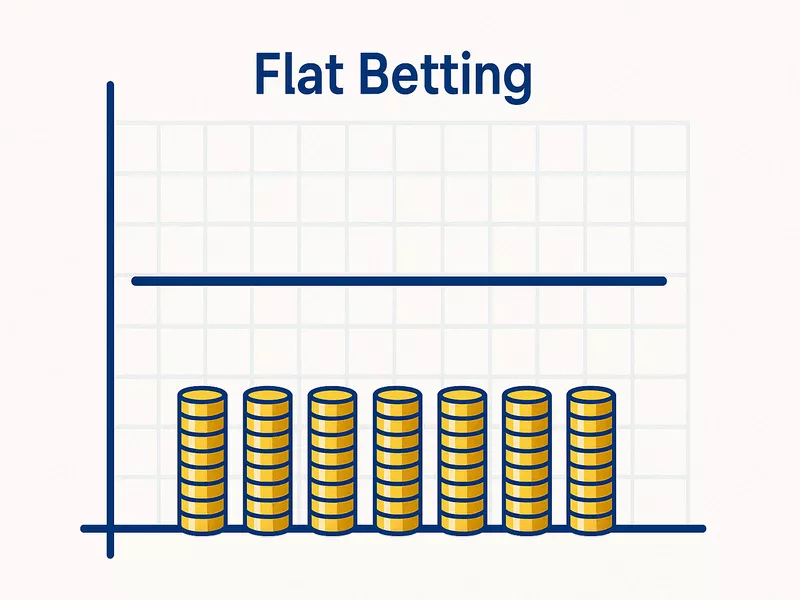
Flat betting maintains consistent stake sizes for stability and risk management
This sounds boring, and it absolutely is. That’s why it works. Boring means you can’t get yourself in trouble. You can’t escalate after losses trying to get even. You can’t press your bets after wins because you feel hot. You can’t convince yourself that this game is special and deserves triple your normal stake. The simplicity removes every psychological trap that destroys bettors.
Professional bettors use flat betting more than any other approach. Some use pure flat betting with zero deviation. Others use modified flat betting where they might occasionally bet two units instead of one, but those situations are clearly defined beforehand and happen rarely. The pros aren’t using flat betting because they lack sophistication. They’re using it because it works and keeps them focused on what actually matters: finding value.
Here’s why flat betting is powerful. First, it makes tracking results trivially easy. You can look at your record and immediately calculate your return on investment. Up 15 units on 100 bets at -110 average odds? You know exactly what your win rate is and whether you’re profitable. No complicated bankroll adjustments to account for. No trying to remember what you bet on different games. Just clean, simple data.
Second, flat betting protects you during losing streaks. Every bettor hits rough patches. The difference between surviving them and going broke often comes down to stake size. If you’re betting one unit when you hit a ten-game losing streak, you’re down ten units but very much alive. If you were using a progressive system that had you betting five units by game ten, you might be crippled or dead.
Third, flat betting prevents the confidence trap. Humans are terrible at assessing their own confidence levels. What feels like a lock is often just a bet you’re emotionally attached to. What feels like a questionable play might be the best value you’ve found all week. Flat betting says that if a bet is worth making, it’s worth one unit. If it’s not worth one unit, it’s not worth making at all. This binary decision-making eliminates a massive source of errors.
The downside is opportunity cost. When you genuinely have a bigger edge on one game versus another, flat betting doesn’t capitalize on that difference. A bet where you estimate 60% probability at even odds has way more value than a bet where you estimate 52% at the same odds. Betting the same amount on both leaves money on the table theoretically.
But here’s the thing: most bettors wildly overestimate their ability to distinguish edge sizes. You think you know when you have a big edge versus a small one, but the data usually shows your “big edge” games don’t hit any more often than your regular plays. The confidence you feel is mostly noise, not signal. For the vast majority of bettors, eliminating this false confidence and betting flat produces better results than trying to scale bets based on feelings.
There are two variations of flat betting worth understanding. Pure flat betting means the same dollar amount regardless of odds. If your unit is 20 dollars, you bet 20 dollars on a -110 favorite, a +150 underdog, or a -200 heavy favorite. The alternative is level risk flat betting, where you adjust the stake to risk the same amount regardless of odds. So you might bet 20 dollars to win 18 at -110, but only bet 13 dollars to win 20 at +150. Both approaches work, though pure flat betting is simpler and more common.
Who should use flat betting? Beginners, absolutely. Anyone without years of tracked data proving they can identify varying edge sizes. People who struggle with emotional betting. Bettors who want to focus on handicapping instead of worrying about stake sizes. If you’re reading this and thinking flat betting sounds too basic for you, there’s a 90% chance you should be using flat betting.
The modified flat betting approach makes sense for more experienced bettors who have data showing they can identify exceptional spots. But even then, the modification should be conservative. Maybe you bet one unit on most plays and two units when specific criteria are met say, beating the closing line by two points on an NFL key number. Never more than three units, and those three-unit plays should be extremely rare. As soon as you’re regularly betting two or three units, you’ve left flat betting behind and entered variable staking, which comes with different risks.
Percentage-Based Betting Systems
Percentage betting adjusts your stake size as your bankroll changes. Instead of betting 20 dollars every time, you bet 2% of your current bankroll. If you’re winning and your bankroll grows to 1,200 dollars, your bet size increases to 24 dollars. If you hit a bad run and drop to 800 dollars, your stake decreases to 16 dollars. The percentage stays constant but the dollar amount floats.
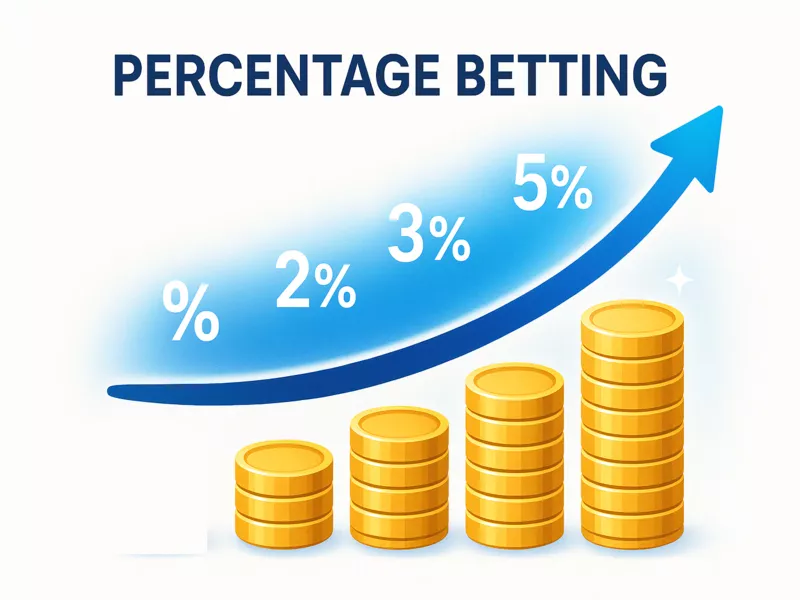
Percentage betting enables compound growth as bankroll increases over time
This automatic adjustment is the key advantage. When you’re winning, percentage betting lets you compound gains by increasing stakes. When you’re losing, it provides built-in protection by reducing exposure. You’re always betting an appropriate amount relative to your capital, which helps prevent both under-betting when you’re flush and over-betting when you’re hurting.
The math works out nicely for long-term growth. Assume you have an edge and you’re making positive expected value bets. With flat betting, your profit curve is linear you’re making roughly the same dollar profit per bet throughout. With percentage betting, your profit curve is exponential. Each win increases your bankroll, which increases your next bet, which increases your next potential profit. Over hundreds or thousands of bets, this compounding effect becomes significant.
The downside is psychological volatility. Your bet sizes are constantly changing, which can mess with your head. You’re betting 20 dollars, then 22, then 19, then 23, and it never feels stable. Some bettors find this unsettling. They want the consistency of knowing every bet is exactly 20 dollars. The floating stakes feel chaotic even though they’re mathematically sound.
There’s also the recalculation burden. You need to check your bankroll before every bet to calculate the correct stake. If you’re betting multiple times per day, this gets tedious. Most percentage bettors compromise by recalculating daily or weekly rather than before every single bet. This introduces small errors but saves massive time and mental energy.
Choosing the right percentage is critical. Conservative bettors use 1% per bet. Standard is 2% to 3%. Aggressive approaches might go to 4% or 5%, though anything above 3% creates serious variance issues. The higher your percentage, the faster you’ll grow when winning but also the harder you’ll crash during losing streaks.
Think about it practically. At 1%, you can lose 50 straight bets and still have half your bankroll left. That’s extreme protection. At 5%, losing 20 in a row cuts you in half. Losing 50 would essentially end you. The aggressive bettor says “I’ll never lose 50 straight because my edge is real.” The conservative bettor says “variance is a thing and I’m not risking my bankroll on assumptions.” Both are right from their own perspective.
Most professionals settle around 2% to 3% because it balances growth and safety. You’re growing meaningfully when things go well without courting disaster when variance turns against you. You can survive a brutal 20-game losing streak and still have 60% to 70% of your bankroll intact. That’s enough to keep betting and let your edge work.
One crucial detail: you need to decide whether to recalculate after every bet, daily, or weekly. Recalculating after every bet is theoretically optimal but practically annoying. Daily recalculation is a good compromise check your balance each morning and use that percentage for the day’s bets. Weekly recalculation is easier but introduces more drift from the true percentage.
The other key decision is whether to count pending bets against your bankroll. Say you have 1,000 dollars and you bet 20 dollars on a game that hasn’t settled yet. Is your bankroll now 980 dollars for calculating your next bet, or still 1,000 dollars? Most bettors ignore pending bets and only adjust based on settled results. It’s simpler and the difference is usually trivial.
Percentage betting makes sense for intermediate to advanced bettors who have proven they’re profitable and want to optimize growth. It’s not ideal for beginners because the floating stakes can be disorienting, and you’re trying to learn handicapping while also managing a dynamic staking system. Master flat betting first, prove you can beat the market consistently, then consider moving to percentage betting to accelerate growth.
The modified version uses percentage betting but with min and max caps. Maybe you’re betting 2% of your bankroll but never less than 10 dollars and never more than 100 dollars. This prevents your stakes from dropping too low when your bankroll is small or exploding when you’re on a major heater. The caps reduce the growth rate but also reduce the psychological swings.
Kelly Criterion and Fractional Kelly
The Kelly Criterion is the mathematically optimal betting system for maximizing long-term growth. It calculates the exact percentage of your bankroll you should bet based on your edge and the odds offered. The formula is f = (bp – q) / b, where f is the fraction to bet, b is the decimal odds minus one, p is your win probability, and q is your loss probability.
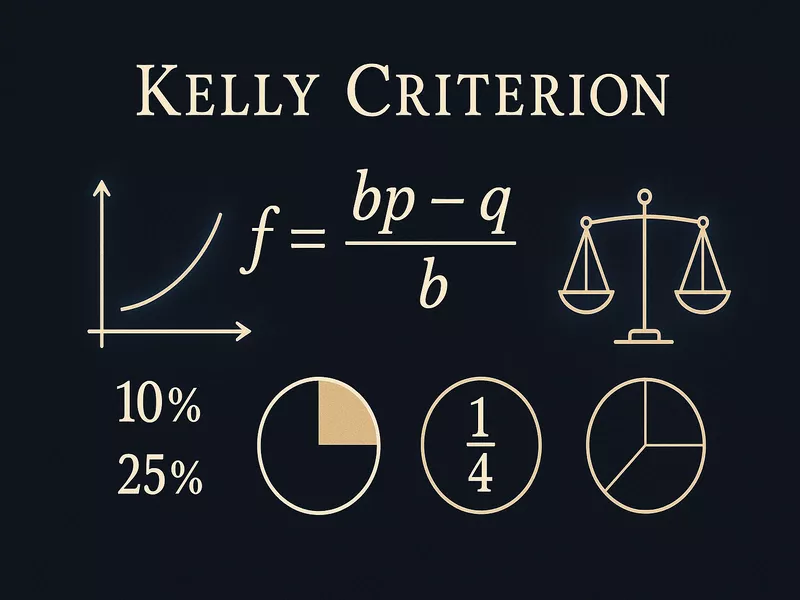
The Kelly Criterion provides mathematically optimal bet sizing for long-term growth
Let’s work through a real example so you see how this plays out. You think an NFL team has a 55% chance to cover the spread. The line is -110, which converts to decimal odds of 1.909. Plugging into Kelly: f = ((1.909-1) × 0.55 – 0.45) / (1.909-1) = (0.50 – 0.45) / 0.909 = 0.055. Kelly says bet 5.5% of your bankroll.
That’s why almost everyone who uses Kelly uses fractional Kelly. Typically half Kelly or quarter Kelly. If full Kelly says bet 10%, half Kelly means bet 5%. If full Kelly says 8%, quarter Kelly means bet 2%. You’re sacrificing some theoretical growth in exchange for massive practical benefits: reduced variance, protection against probability estimation errors, and bankroll swings you can actually tolerate psychologically.
Fractional Kelly is the only version that makes sense for sports betting. Full Kelly is academically interesting but practically unusable unless you have perfect information, which you don’t. Even professional bettors with sophisticated models use fractional Kelly, usually around quarter to half. They know their models aren’t perfect and they’d rather sacrifice a bit of growth than risk blowing up.
Kelly works best for bettors who have proven edges, historical data supporting their win rates, the mathematical comfort to calculate stakes, and the psychological fortitude to handle variance. If any of those pieces is missing, you’re better off with simpler systems. Kelly is a powerful tool in the right hands and a hand grenade in inexperienced ones.
Progressive Betting Systems
Progressive systems adjust stakes based on recent results. They come in two flavors: negative progression increases bets after losses, positive progression increases bets after wins. Both sound logical superficially. One tries to recover losses quickly, the other capitalizes on hot streaks. Both are usually terrible ideas, but for different reasons.
Negative progression systems like Martingale are the most famous and most dangerous. The basic Martingale doubles your bet after every loss. You bet 10 dollars and lose. Next bet is 20 dollars. Lose again, bet 40. Then 80, then 160, then 320. The theory is that eventually you’ll win and recover all previous losses plus profit equal to your original stake.
The math seems sound until you run into reality. First, you’ll hit losing streaks longer than you expect. Five straight losses isn’t unlikely, it’s normal variance. Seven losses happens regularly. Ten losses is rare but not remotely impossible. Each loss doubles your next required bet. After just seven losses starting at 10 dollars, you need to bet 1,280 dollars just to win back your original 10. That’s not betting, that’s desperation.
Second, sportsbooks have maximum bet limits. Even if you have infinite money, the book won’t let you bet 10,000 dollars to recover from a bad streak. The system literally cannot work past a certain point. Third, you’re risking enormous amounts to win tiny profits. After nine straight losses, you’re betting 5,120 dollars to profit 10 dollars. The risk-reward is insanely skewed.
But the real problem with Martingale is it doesn’t change the fundamental math. Every bet still has the same expected value. You’re just risking more after losses, which means variance will eventually destroy you. It’s not a matter of if, it’s a matter of when. Every single person who has ever used Martingale long-term has either quit or gone broke. There are no exceptions.
Variations like the D’Alembert system are slightly less aggressive but still fundamentally flawed. D’Alembert increases your bet by one unit after losses and decreases by one unit after wins. It’s slower than Martingale but eventually fails for the same reasons. Any system that increases stakes after losses is fighting against mathematics and will lose that fight.
For any serious bettor trying to maximize profit, progressive systems are a mistake. They feel active and strategic, which is why people love them. But feeling like you’re doing something smart and actually doing something smart are different things. The best betting systems are often boring precisely because they don’t try to be clever. They just stake optimally and let the edge do the work.
Choosing the Right System for Your Situation
Here’s how to actually pick a system instead of just randomly trying whatever sounds interesting. Start by honestly assessing your situation across four dimensions: experience level, bankroll size, risk tolerance, and time commitment. Your answers determine which systems make sense and which ones will destroy you.
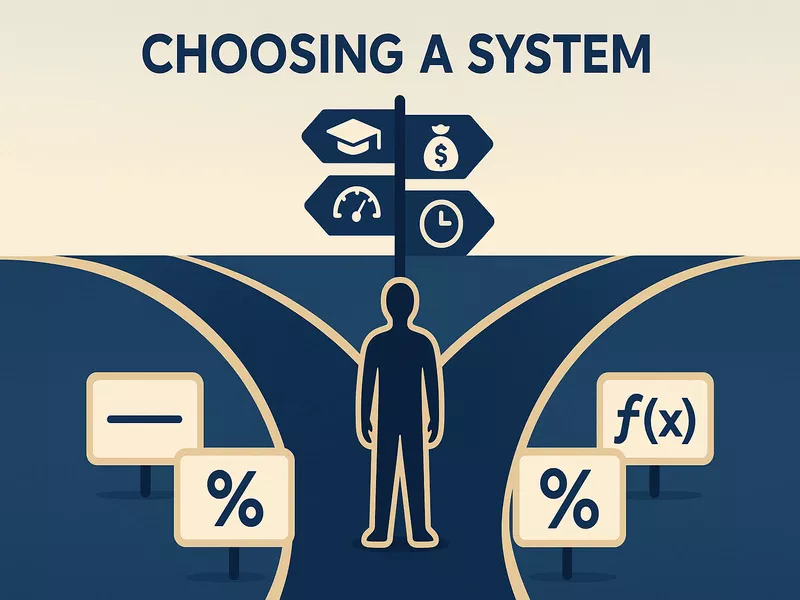
Choose your betting system based on experience, bankroll size, risk tolerance, and time commitment
Experience level matters more than people admit. If you’ve been betting seriously for less than a year or have fewer than 500 tracked bets, you should be using flat betting. Full stop. You don’t have enough data to know your true edge, your win rates by situation, or how you respond psychologically to variance. More complex systems will just add variables that obscure whether you actually have an edge or not. Master the basics before adding complexity.
Bankroll size affects which systems are practical. With 300 dollars, percentage betting breaks down because your stakes get too small to be meaningful. You’re betting 3 to 6 dollars per game, and most sportsbooks have 5 or 10 dollar minimums. You’ll either violate your system or not be able to bet. Flat betting with a fixed 5 or 10 dollar unit makes more sense at small bankrolls. Once you’re above 1,000 dollars, percentage systems become practical.
Don’t skip steps. Every bettor wants to be advanced immediately, but you can’t build a house starting with the roof. Prove you can win with simple systems before adding complexity. The number of bettors who would be profitable with flat betting but go broke using Kelly because they overestimate their edge is staggering. Simple works. Stick with simple until you have overwhelming evidence you need something more.
One last consideration: your betting style affects system choice. If you’re betting mostly favorites at -110 to -150, Kelly recommends relatively stable stakes. If you’re betting big underdogs at +200 to +400, Kelly gets more aggressive because the potential payouts are larger. Your system needs to match the types of bets you make. A system optimized for frequent bets at even odds performs differently than one designed for occasional longshots.
The other factor is bet volume. High-volume bettors making ten or twenty bets daily can use more aggressive systems because the law of large numbers kicks in faster. Your results converge toward expectation quicker with more trials. Low-volume bettors making three bets per week need more conservative approaches because they’re more exposed to variance over any given time period.
Betting Systems: Summary and How to Match a System to Your Bankroll
Betting systems don’t pick winners. They don’t find value. They don’t magically turn losing bets into profits. What they do is manage risk and optimize how you extract value from genuine edges. The right system for your situation protects your bankroll when things go wrong and maximizes growth when things go right. The wrong system gets you broke while you’re still trying to figure out what happened.
The best betting system is the one you’ll stick with during losing streaks. That’s the only metric that actually matters. A theoretically suboptimal system that you follow religiously beats the optimal system that you abandon after two bad weeks. Pick something that matches your personality, your risk tolerance, and your bankroll. Start conservative, track everything, and adjust only when you have data supporting the change.
Stop looking for the magic system that solves everything. It doesn’t exist. Start looking for the system that fits your situation, protects your downside, and lets you stay in the game long enough for your edge to matter. That system exists, and now you know how to find it.
See also: betstrategytips – all betting systems explained.
See also: Sport-Specific Betting Strategies – apply systems to your favourite sport.
