
Value Betting: How to Find Profitable Betting Opportunities
 Available in US
Value Betting: Why Finding Edge Is the Foundation of Profitable Wagering
Value betting is the only way to make money sports betting long-term. Not handicapping skill. Not insider information. Not betting systems or progressive staking. Value. If you’re not consistently finding and betting situations where the odds are better than they should be, you’re not going to profit no matter how sophisticated your approach seems or how confident you feel about your picks.
Most bettors completely misunderstand what value means. They think value betting is finding teams that will probably win. It’s not. Value betting is finding situations where the probability of an outcome is higher than what the bookmaker’s odds imply. You can find value on a team with a 35% chance to win if the odds suggest they only have a 30% chance. You can bet value and lose most of the time as long as you’re getting paid more than the true probability justifies.
This is why so many bettors lose despite being decent handicappers. They pick winners at a respectable rate, maybe 53% or 54%, but they’re betting at random prices without considering whether those prices offer value. Sometimes they’re getting 53% probability on bets that require 55% to break even. They’re winning more than they’re losing but still bleeding money because they’re not getting paid appropriately for the risk they’re taking.
Value betting requires a fundamental mindset shift from outcome thinking to process thinking. You’re not asking “will this team win?” You’re asking “is the price I’m getting better than the true probability?” The first question makes you a predictor. The second question makes you an investor. Predictors can be right and still lose money. Investors can be wrong and still profit over time if they’re consistently getting value.
This guide breaks down everything you need to understand about value betting. We’ll cover how to calculate expected value mathematically, how to estimate true probabilities more accurately than the market, where to find value in betting markets, how line shopping creates value opportunities, and why closing line value is the metric that actually predicts long-term profitability.
If you’re currently betting based on which teams you think will win without considering price, you’re playing a different game than successful bettors are playing. They’re not trying to pick winners, they’re trying to buy assets below fair value and sell them above fair value. The fact that the assets are sports bets instead of stocks doesn’t change the fundamental principle: buy low, sell high, repeat forever. That’s value betting.
Understanding Expected Value
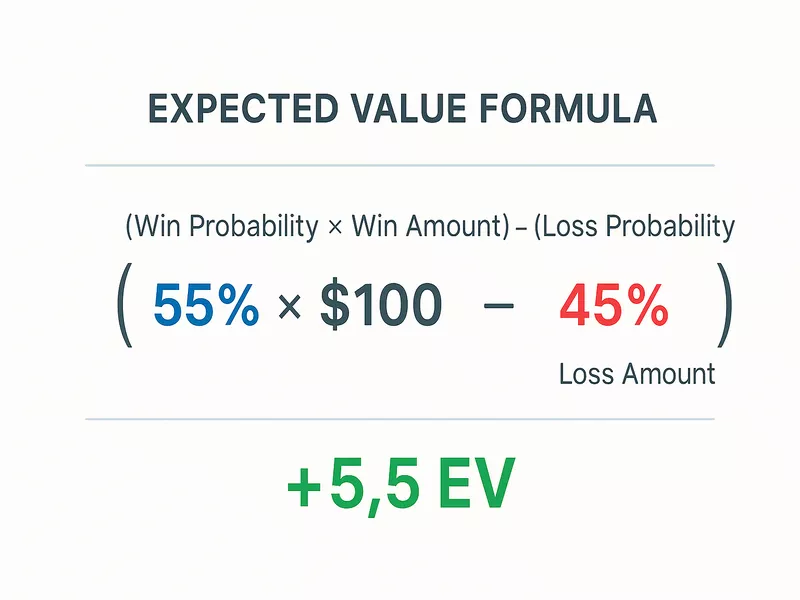
Expected value is the mathematical foundation of value betting. It’s the average outcome you’d expect over infinite repetitions of a bet. The formula is simple: EV = (Probability of Win × Amount Won) – (Probability of Loss × Amount Lost). When EV is positive, the bet is profitable over time. When it’s negative, you lose money long-term regardless of short-term results.
Let’s work through a concrete example so you understand how this plays out. You’re looking at an NFL spread bet at -110 odds. You bet 110 dollars to win 100. You estimate the team has a 55% chance to cover. What’s the expected value? EV = (0.55 × 100) – (0.45 × 110) = 55 – 49.5 = +5.5. Your expected value on this 110 dollar bet is positive 5.5 dollars, which means over many repetitions, you average about 5 dollars profit per bet.
Now consider the same scenario but your probability estimate is 52% instead of 55%. EV = (0.52 × 100) – (0.48 × 110) = 52 – 52.8 = -0.8. Your expected value is negative 80 cents. You’re losing money on this bet long-term even though you’re slightly more likely to win than lose. This is how bettors with 52% win rates go broke they’re winning more than they’re losing but not getting paid enough to overcome the vig.
The critical insight is that expected value is the only thing that matters over large samples. Short-term results are noise. You can bet negative EV and win. You can bet positive EV and lose. Individual outcomes don’t validate or invalidate the bet. What matters is whether the price you’re getting exceeds the true probability often enough that your cumulative expected value over hundreds of bets is positive.
Most recreational bettors never calculate expected value because it requires estimating true probabilities, which is hard. Instead, they use confidence as a proxy for value. “I’m really confident about this bet” becomes their justification for betting. But confidence and value are different things. You can be extremely confident and still be wrong about the probability. You can be uncertain and still have positive expected value if the odds are inflated enough.
Professional bettors calculate expected value on every bet before placing it. They have models, power rankings, situational databases, and statistical approaches that help them estimate true probabilities. Then they compare those probabilities to the implied probabilities from bookmaker odds. When their estimated probability exceeds the implied probability by enough to overcome the vig, they bet. When it doesn’t, they pass regardless of how much they like the team.
The “enough to overcome the vig” part is crucial. At -110 odds, the breakeven point is 52.4%. So if you estimate 53% probability, your edge is only 0.6%. That’s positive EV technically, but it’s razor thin. Most professionals want to see at least 2% to 3% edge before betting because probability estimation has error margins. You might think you’re 54% when you’re actually 52%. Building in a cushion protects you from over-betting situations where your perceived edge doesn’t exist.
The other key aspect of expected value is that it compounds over time. A bet with +5 EV isn’t interesting on its own. Make that bet 100 times and your expected profit is 500. Make it 1,000 times and you’re expecting 5,000 in profit. Volume turns small edges into meaningful income. This is why sharp bettors focus on finding consistent value rather than trying to hit big longshots. Small edges repeated frequently beat big edges hit occasionally.
Expected value also explains why betting systems don’t matter if you’re making -EV bets. The Martingale, Fibonacci, whatever none of them change the fundamental expected value of your bets. If you’re betting -EV, you lose money whether you’re using flat stakes or progressions. Systems just determine how fast you lose and how much variance you experience. Only positive EV bets produce profit, and only value betting consistently finds positive EV bets.
Estimating True Probability
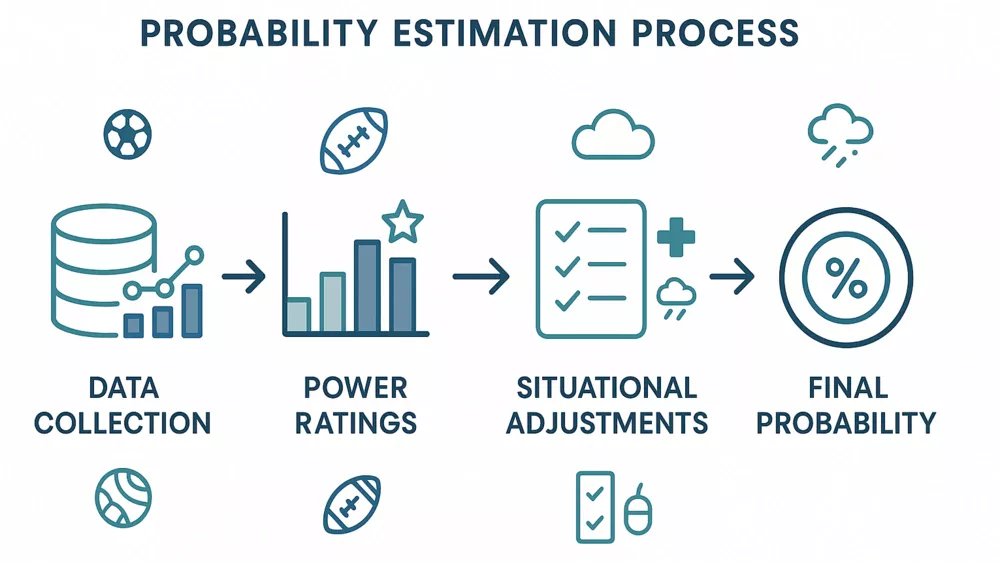
Calculating expected value requires knowing the true probability of an outcome, which is where most bettors struggle. The bookmaker gives you odds that imply a probability, but those odds include the vig and might not reflect the actual likelihood of the outcome. Your job is to estimate the true probability more accurately than the market does, which sounds impossible but is achievable with the right approach.
The first step is understanding that probability estimation isn’t guessing. It’s research-driven analysis based on historical data, situational factors, and statistical models. Professional bettors don’t look at a game and go with their gut. They analyze dozens of variables, compare current situations to historical patterns, adjust for context, and arrive at probability estimates grounded in data rather than intuition.
For sports bettors, several approaches help estimate probabilities. Power ratings assign numerical values to each team’s strength and use the difference between ratings to project outcomes. Historical databases show how teams perform in similar situations. Regression analysis identifies which statistics correlate with winning. Advanced metrics like expected goals in soccer or DVOA in football provide better predictors than traditional stats. The more data-driven your approach, the more accurate your probability estimates become.
Let’s walk through a simplified example of estimating probability for an NFL game. You’re looking at Ravens at Steelers. Start with power ratings maybe you rate Baltimore as a 3-point better team on a neutral field. Adjust for home field advantage, which is worth about 2.5 points in the NFL currently. Steelers get the 2.5 points for being home, making them a 0.5-point favorite in your estimation. Then adjust for situational factors: Is anyone injured? Coming off short rest? Division game with extra motivation? Weather concerns?
After all adjustments, you land on Steelers -1 as your fair line. The bookmaker has Steelers -3. That two-point difference is meaningful. At -1, Steelers might have a 52% to 53% win probability. At -3, they need closer to 58% to 59%. If your line is accurate and the market line is inflated, Ravens as 3-point underdogs might be a value bet even though they’re less likely to win outright.
The challenge is that your power ratings and adjustments need to be accurate. If your process is flawed, your probability estimates are garbage, which means your expected value calculations are meaningless. This is why professionals spend years refining their models and tracking results to calibrate their probability estimates. They’re constantly checking their estimated probabilities against actual outcomes to identify biases and errors in their process.
For bettors without sophisticated models, simpler approaches can still work. You can use market-based probability estimation where you assume the closing line is sharp and work backward from there. If a team closes at -3 (roughly 58% to 60% implied probability) and you think the market is wrong, you need specific reasons based on information or analysis the market doesn’t have. This is harder than building your own probabilities, but it keeps you tethered to reality.
Another approach is consensus-based estimation. Look at several sharp books and see where their lines converge. The consensus among Pinnacle, Bookmaker, and other sharp outlets represents the sharpest available opinion on probabilities. When you disagree with that consensus, you need strong justification maybe late-breaking injury news, weather developments, or situational analysis the market hasn’t fully absorbed. Betting against sharp consensus without edge is donation, not investment.
The margin of error in probability estimation is larger than most bettors realize. Estimating that a team has a 54% chance to cover when they actually have 52% or 56% is normal imprecision. This is why many professionals only bet when they perceive significant edges 3% or more difference between their estimated probability and implied probability. Smaller edges might not exist once you account for estimation error, so betting them is risky.
One practical technique is keeping a probability journal. For every bet you make, write down your estimated win probability before the game. After accumulating 100 to 200 bets, compare your estimates to actual results. If you estimated 55% on twenty bets and they went 9-11, you’re overestimating probabilities by about 10 percentage points. That’s crucial feedback that helps you calibrate your estimates going forward. Most bettors skip this step and never learn where their estimation process breaks down.
Finding Value in Betting Markets
Value exists in betting markets for several reasons, and understanding where it comes from helps you find it consistently. Markets aren’t perfectly efficient. Information isn’t distributed evenly. Public betting creates biases. Different books have different risk tolerances. These inefficiencies create opportunities, but only for bettors who know where to look and how to act on them.
Public betting bias is the most accessible source of value for serious bettors. The public loves betting favorites, overs, and popular teams. This creates systematic line distortions where favorites are overpriced and underdogs underpriced, overs are overpriced and unders underpriced, popular teams are overpriced and unpopular teams underpriced. Not always, but often enough that fading the public becomes a viable strategy.
The classic example is prime time NFL games featuring popular teams. Cowboys, Packers, Patriots these teams draw massive public money regardless of the matchup. When they’re favorites, the line often moves toward them even though sharp money might be on the other side. This reverse line movement line moving toward the team getting less sharp action signals value on the unpopular side. You’re betting against public bias, which means you’re getting inflated odds.
Another source of value is late-breaking information. Injury reports come out Friday and Saturday in the NFL. Weather forecasts update throughout the week. Lineup announcements in NBA happen an hour before tip-off. When you have access to information before it’s fully reflected in the line, you have a temporary edge. The key is acting quickly because sharp money moves lines fast once information becomes public.
Niche markets and lower-tier sports often have softer lines than major markets. The NFL and NBA lines are razor sharp because they attract the most betting volume and the sharpest bettors. But college football Tuesday MACtion game between Toledo and Bowling Green? The book hasn’t invested as much resources setting that line. If you specialize in a niche the market doesn’t focus on, you can find value that doesn’t exist in mainstream markets.
Derivative markets sometimes offer better value than main markets. Instead of betting the spread, maybe the first half spread or first five innings has a better number. Instead of betting moneyline, maybe an alternate spread provides better odds. Player props occasionally have softer lines than game totals. Books set hundreds of markets per game, and they can’t all be equally sharp. Finding the soft spots requires exploring beyond the main markets everyone bets.
Line shopping creates value mechanically. If one book has Ravens +3 and another has Ravens +3.5, the half-point difference is value. Over hundreds of bets, consistently getting the best available line adds several percentage points to your ROI. Most recreational bettors use one book and bet whatever number is posted. Professionals have accounts at five to ten books and always take the best line available. That discipline compounds into significant profit over time.
Timing also matters for value. Early week lines in NFL are generally softer than closing lines because less information is available. Sharp bettors often bet early to beat line moves. Conversely, waiting until close to game time captures all available information including injury news and weather updates. There’s no universal best time to bet it depends on whether you have information edge early or want the sharpest possible closing number.
Steam moves rapid line movements caused by sharp money indicate where value existed before the move. When a line moves from -3 to -4.5 in fifteen minutes, sharp bettors hammered that side. You’re too late to get the value they got, but you can learn from the move. Tracking which types of games attract sharp money helps you identify situations where value consistently emerges. Over time, you develop pattern recognition that helps you spot value before the market moves.
Contrarian betting taking unpopular sides is a value-finding approach rather than a rigid system. When 75% of bets are on one side but the line isn’t moving or is moving the opposite direction, that’s sharp money on the unpopular side. The public is creating artificial line inflation on one side, which means the other side has value. This doesn’t mean blindly fading the public, it means using public betting data as one input in your value assessment.
Line Shopping and Multiple Accounts
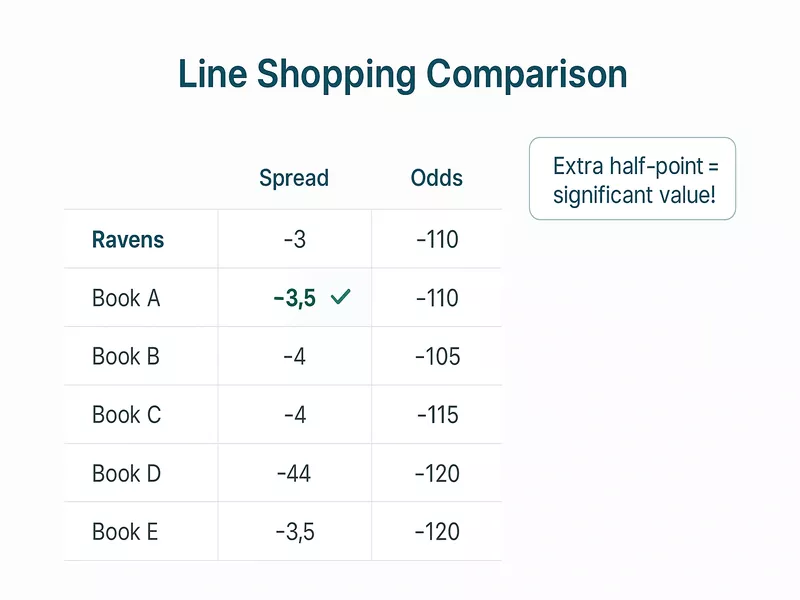
Line shopping is mandatory for serious value bettors. Not optional, not nice-to-have, mandatory. The difference between betting at one book and shopping lines across multiple books is several percentage points of ROI annually. Over thousands of bets, that’s thousands of dollars left on the table by bettors too lazy to open additional accounts and compare numbers.
Consider the mathematics. You’re betting NFL spreads at -110 average odds. To break even, you need to win 52.4% of your bets. Now imagine you could improve to -105 average odds through line shopping. Your breakeven drops to 51.2%. That’s 1.2% fewer wins required for the same outcome. In a season of 100 bets, that’s one to two extra wins worth of value created purely by getting better prices. You’re not handicapping better, you’re just shopping better.
Half points matter enormously in football. Getting -2.5 instead of -3 on an NFL spread is massively valuable because three is the most common margin of victory. Getting +7.5 instead of +7 similarly crosses a key number. In a season of NFL betting, consistently capturing the better side of key numbers through line shopping might be worth 3% to 5% ROI. That’s often the difference between winning and losing bettors at similar handicapping skill levels.
Opening accounts at multiple sportsbooks takes an afternoon. Maintaining them requires minimal effort. Checking lines across books before betting takes thirty seconds. The laziness of not line shopping is essentially setting money on fire because you couldn’t be bothered to click three extra times before placing a bet. When you frame it that way, not line shopping seems insane.
Which books should you have accounts with? Start with the major regulated books in your jurisdiction DraftKings, FanDuel, BetMGM, Caesars. These books often have different lines because they’re managing different customer bases and risk profiles. Add offshore books like Bookmaker and Heritage if you’re serious, as they often post sharper lines that can reveal value elsewhere. Having accounts at five to seven books covers most line shopping needs.
The process is straightforward. You’ve handicapped a game and decided you want to bet Ravens. Before placing the bet, you check all your accounts. One book has Ravens +2.5, another has +3, another has +2.5 but at better odds. You take the +3 because the extra half-point is worth far more than minor odds differences. This simple action of shopping before betting adds up over time into massive value accumulation.
Some bettors resist line shopping because managing multiple accounts seems complicated. It’s not. Most books have mobile apps. You can check all your accounts in under a minute. Some bettors use odds comparison websites that aggregate lines from multiple books, making shopping even faster. The slight inconvenience is minuscule compared to the value gained. Anyone serious about profiting from sports betting must line shop, period.
The other benefit of multiple accounts is avoiding limits. Books limit or ban winning bettors regularly. When you have accounts at multiple places, losing access to one doesn’t end your betting. You maintain access to markets through your other accounts. This redundancy is crucial for longevity in sports betting.
Line shopping discipline also prevents you from betting games you shouldn’t bet. If you only have one account and a line looks marginal, you might convince yourself to bet it because it’s there. When you have multiple accounts and you’re checking numbers, you’re more likely to see that the line is mediocre across the board and pass entirely. The shopping process builds in a quality filter that improves your bet selection.
Closing Line Value as the Key Metric
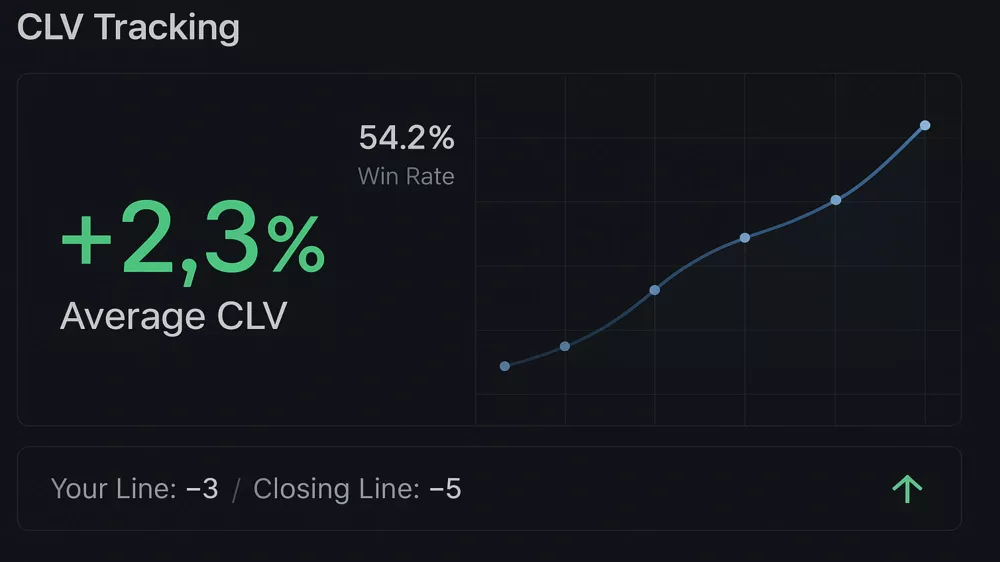
Closing line value is the single most important metric for evaluating your betting performance. Not win rate. Not return on investment. Not profit. Closing line value. It measures the difference between the odds you bet at and the closing line right before the game starts, and it predicts long-term profitability better than any other metric.
The closing line is the sharpest line. It incorporates all available information, all the sharp money, all the market movement, everything. It represents the best collective estimate of true probability. When you consistently beat the closing line getting better odds than the final number you’re demonstrating an edge. Even if your short-term results are negative because of variance, positive CLV indicates you’re making +EV bets that will profit given enough volume.
Here’s a concrete example. You bet Ravens +3 on Tuesday. By Sunday kickoff, the line has moved to Ravens +1. You beat the closing line by two points. Even if the Ravens lose and your bet loses, you made a good bet. You got better odds than the market ultimately settled on, which means you were ahead of the curve. Do this consistently and you’re a winning bettor, even if any individual stretch of results doesn’t show it yet.
Conversely, negative CLV is a massive red flag. You bet Steelers -3, the line moves to Steelers -5 by kickoff. You bet worse odds than the final number. The market is telling you that your bet was on the wrong side of fair value. Maybe you still win because variance is real, but you made a -EV bet. Do this consistently and you’re a losing bettor long-term regardless of short-term results.
Professional bettors obsess over CLV more than any other metric. They track it meticulously on every bet. After 500 bets, if their average CLV is positive, they know they have an edge and profits will come eventually. If their average CLV is negative, they know their process needs work regardless of whether they’re currently up or down money. CLV is the signal, results are noise.
The reason CLV is so predictive is it measures whether you’re providing value to the market or taking value from the market. When you get positive CLV, you’re buying assets below market consensus value. When you get negative CLV, you’re buying assets above market consensus value. Over time, consistently buying below value creates profit, consistently buying above value creates losses. It’s that simple.
One counterintuitive aspect of CLV: you can lose money in the short term while maintaining positive CLV, and this is actually fine. Variance means results lag process. Your probability estimates might be accurate on average but wrong in stretches. What matters is that the prices you’re getting are better than the final market prices. The law of large numbers says if you keep getting positive CLV, results will eventually converge toward expectation.
To track CLV effectively, you need to record the odds you bet at and the closing line for every bet. After each game, note the line movement. If you bet early, lines might move significantly before close. If you bet late, movements are smaller but still meaningful. Over 100 bets, calculate your average CLV. Positive average CLV means you’re beating the market. Negative means you need to adjust your approach.
Different betting strategies produce different CLV profiles. Betting early in the week often produces higher CLV because you’re ahead of market movements, but you’re also betting with less information. Betting close to game time produces lower CLV but incorporates more information. Neither approach is universally better it depends on whether your edge comes from information or from identifying value before the market moves.
Some bettors achieve positive CLV by betting immediately after lines are posted before sharp money moves them. Others achieve it by having information edges that let them predict line movements. Still others achieve it by specializing in markets where books are less sharp. The method matters less than the result consistent positive CLV indicates you’re finding and betting value successfully.
The final insight about CLV is it gives you permission to ignore short-term results. Betting is psychological torture because you can do everything right and still lose money for stretches due to variance. CLV provides an objective measure that your process is sound even when results are painful. It’s the difference between “I’m losing so I must be doing something wrong” and “I’m losing but my CLV is positive so I just need to wait for variance to even out.” That psychological anchor is invaluable.
Value Betting: Summary and How to Spot Your First Value Opportunities
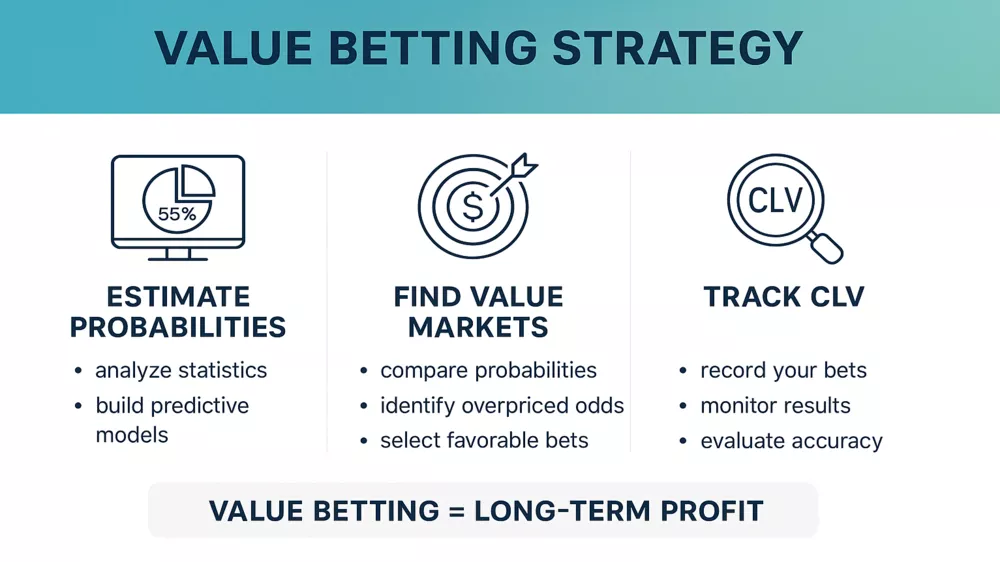
Value betting is the only sustainable approach to profitable sports betting. Everything else handicapping skill, bankroll management, betting systems matters, but only if you’re consistently finding and betting situations where your estimated probability exceeds the implied probability from the odds. Without value, you’re gambling rather than investing, and gambling is a losing proposition over time.
Finding value requires three core skills. First, you need to estimate probabilities more accurately than the market, which demands research, data analysis, and calibrated judgment. Second, you need to identify where value exists in markets, whether through public bias, information edges, niche specialization, or line shopping discipline. Third, you need to measure your success through closing line value rather than short-term results, which keeps you focused on process rather than noise.
Value betting isn’t sexy or exciting. It’s patient, disciplined, process-oriented betting where you make decisions based on probabilities and prices rather than feelings and predictions. But boring and profitable beats exciting and broke every single time. Find value, bet value, track CLV, repeat forever. That’s the game.
See also: betstrategytips – explore all betting strategies.
See also: Martingale Betting System – combine value bets with a staking system.
