
Martingale and Progressive Betting Systems: Do They Work?
 Available in US
Martingale System: Why Progressive Betting Attracts and Fails Bettors
Let’s start with the answer you’re looking for: no, progressive betting systems don’t work for sports betting. Not the Martingale, not the Fibonacci, not the fancy-sounding systems with Italian names that make them sound sophisticated. They feel like they should work because the logic seems airtight, but feeling right and being right are dramatically different things when mathematics is involved.
The Martingale system has probably destroyed more bankrolls than any other betting approach in history. It’s seductive because the pitch is perfect: just double your bet after every loss, and when you finally win, you’ll recover everything you lost plus a small profit. You can’t lose in the long run, right? Except you absolutely can, and you absolutely will, and the question isn’t whether the system fails but how spectacularly it fails when variance inevitably turns against you.
Progressive betting systems represent humanity’s desperate attempt to impose order on randomness. We want patterns. We want predictability. We want to believe that if we just bet more after losses, we can control outcomes through sheer financial force. But sports betting doesn’t care about your betting history. The spread doesn’t know you just lost seven in a row. The game doesn’t adjust its outcome based on how much you’re wagering. Each bet is an independent event, and pretending otherwise is expensive.
This guide breaks down every major progressive system you’ll encounter: Martingale, Reverse Martingale, Fibonacci, D’Alembert, Labouchere, and several others. We’ll explain exactly how each one works, run through real-world scenarios showing where they break, and examine why they feel so appealing despite being mathematically doomed. We’ll also cover the rare situations where progressive betting might make sense, though those situations are rarer than you think.
The goal isn’t to convince you that all betting systems are worthless. Flat betting works. Percentage betting works. Fractional Kelly works. But progressive systems specifically the ones that adjust stakes based on recent results range from mildly suboptimal to catastrophically dangerous. By understanding exactly why they fail, you’ll save yourself the expensive education that thousands of bettors before you have paid for.
If you’re reading this because you’re already using a progressive system and want validation, you won’t find it here. What you’ll find instead is a clear explanation of why your current approach is more dangerous than you realize, what will eventually happen if you continue, and what you should do instead. Sometimes the kindest thing you can tell someone is that their plan won’t work before they lose money proving it themselves.
Understanding Progressive Betting Systems
Progressive betting systems come in two flavors: negative progression and positive progression. Negative progression increases your bet size after losses. Positive progression increases your bet size after wins. Both operate on the assumption that recent results tell you something useful about future outcomes. That assumption is wrong, but understanding why people believe it helps explain why these systems persist despite overwhelming evidence against them.
Negative progression systems are based on the gambler’s fallacy the belief that after a string of losses, a win becomes more likely. If you flip a coin and get tails five times in a row, your brain screams that heads is due. But the coin has no memory. The sixth flip is still 50/50. Sports betting works the same way. If you lose seven spread bets in a row, bet eight doesn’t have a higher probability of winning just because you’re on a cold streak. The universe doesn’t owe you a win to balance things out.
The appeal of negative progression is psychological, not mathematical. When you’re losing, you feel powerless. Increasing your bet size feels like taking action, like fighting back against bad luck. It’s the same impulse that makes people chase losses at the poker table or double down at blackjack after a bad run. You’re not making a strategic decision, you’re having an emotional response to loss aversion. Your brain hates being down money more than it likes being up money, so it tricks you into thinking bigger bets will fix the problem faster.
Positive progression systems feel safer because you’re increasing stakes when you’re winning, not when you’re desperate. The logic is that you should press your advantage during hot streaks and protect your bankroll during cold ones. This makes intuitive sense, which is why positive progression systems are popular among bettors who’ve learned that Martingale is dangerous but still want something more exciting than flat betting.
The problem with positive progression is more subtle but still fatal: winning streaks aren’t predictive. Just because you won the last three bets doesn’t mean bet four is more likely to win. Hot and cold streaks feel real when you’re experiencing them, but when you look at long-term betting data, they’re usually just random variance that your pattern-seeking brain interprets as meaningful. You’re betting more at arbitrary points that feel significant but mathematically aren’t.
Every progressive system shares a fundamental flaw: they change how much you bet without changing the expected value of your bets. If you’re making -EV bets, progressions make you lose faster. If you’re making +EV bets, progressions make you win slower than optimal staking would. The only time progressions could theoretically help is if your ability to identify value changes based on recent results, which is possible but unlikely and definitely not what the systems are designed around.
The other universal problem is that progressive systems amplify variance. When you’re betting more during specific sequences whether that’s after losses or after wins you’re creating bigger bankroll swings than steady staking would. Higher variance means higher risk of ruin, which means you need a bigger bankroll cushion to survive the same win rate. You’re making your journey more difficult without improving your destination.
Understanding why people use progressive systems despite their flaws requires looking beyond mathematics into psychology. Flat betting is boring. It requires patience and discipline. Progressive systems feel active and strategic. They give you something to do, a system to follow, a sense of control over chaos. That feeling of control is an illusion, but illusions are powerful. The casinos in Las Vegas weren’t built by people making mathematically optimal decisions.
The Classic Martingale System
The Martingale is the grandfather of progressive betting systems and the most dangerous. The rules are simple: start with a base bet, double your stake after every loss, return to the base bet after any win. The theory is that no matter how long you lose, one win recovers all previous losses plus profit equal to your original stake.
Let’s walk through a concrete example so you see exactly how this plays out. You start with a 10 dollar bet on an NFL spread at -110 odds. You lose. Your next bet is 20 dollars. Lose again, bet 40. Then 80, then 160, then 320, then 640, then 1,280. After seven straight losses which happens more often than you’d think you need to bet 1,280 dollars to recover your losses and profit 10 dollars. You’ve risked a cumulative 2,540 dollars to win back 10. The risk-reward ratio is absolutely insane.
But wait, it gets worse. After those seven losses, you finally win your 1,280 dollar bet at -110 odds. You get back 1,280 plus about 1,164 in profit, for a total return of roughly 2,444 dollars. Your cumulative risk was 2,540, so you’re up about 10 dollars total after this nightmare sequence. One more loss and you would’ve needed to bet 2,560 dollars on the next game. Can your bankroll handle that? More importantly, will your sportsbook even accept a 2,560 dollar bet from you?
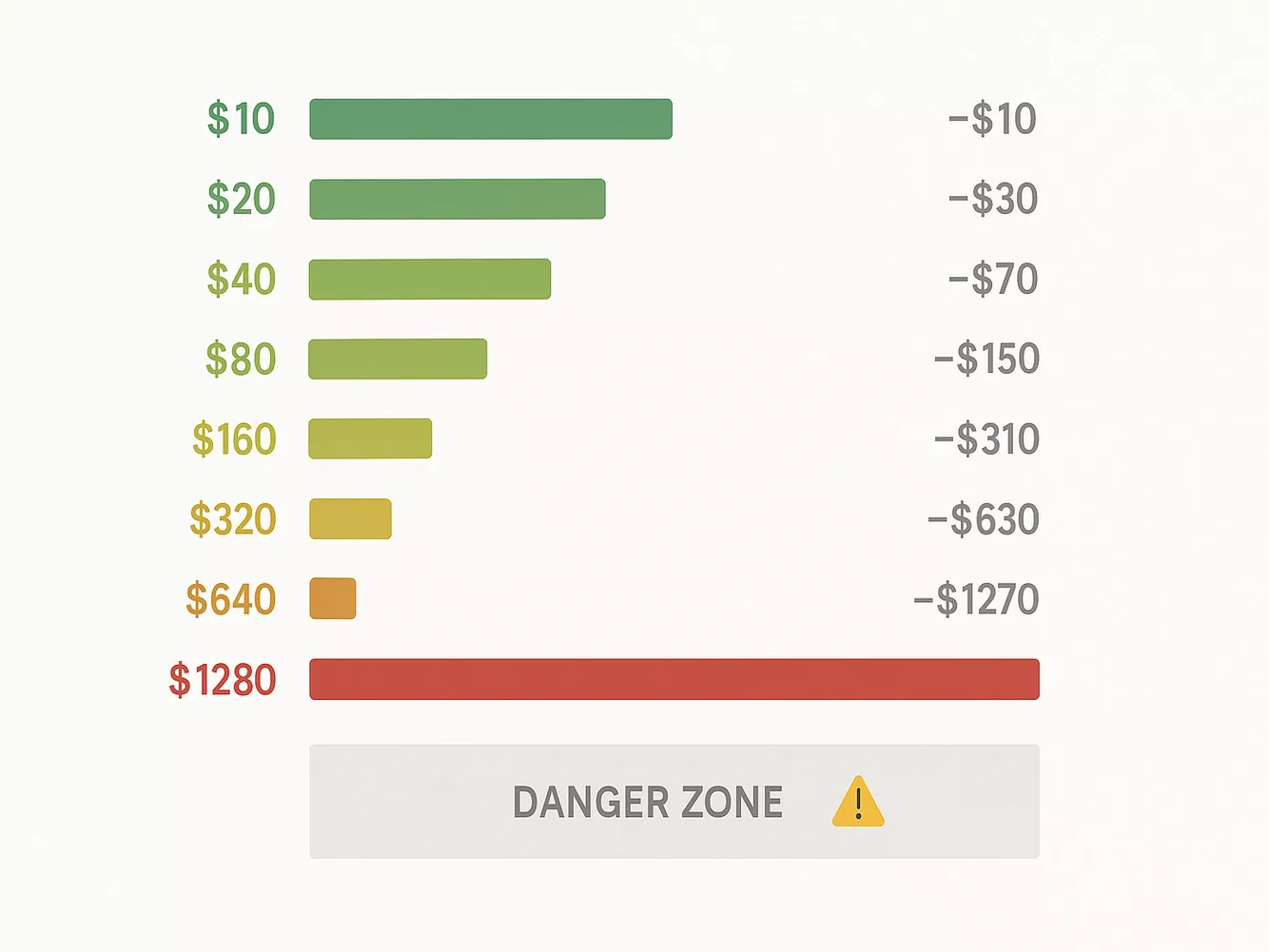
This is where Martingale crashes into reality: betting limits exist. Every sportsbook has maximum bet sizes. Even if you had infinite money which you don’t the book will cap you somewhere between 1,000 and 10,000 dollars depending on the sport and market. Once you hit that limit, the system literally cannot continue. You’re trapped in a losing sequence with no way to double again, which means all the previous logic collapses. The system only works with infinite money and no betting limits, which describes approximately zero situations in the real world.
The psychological damage happens long before you hit betting limits. Imagine being down 1,270 dollars after seven losses, knowing that if you lose the next 1,280 dollar bet, you’re down 2,550 total. The stress is crushing. Your judgment deteriorates. You start hoping instead of thinking. You take worse lines because you need to get a bet down. You chase steam because you’re desperate for any winner. The system hasn’t just damaged your bankroll, it’s destroyed your decision-making process.
Here’s the statistical reality that Martingale ignores: losing streaks are normal. With a 50% win rate, you’ll lose seven or more in a row about 0.8% of the time. That sounds rare until you realize that if you’re betting regularly, you’ll hit this situation multiple times per year. With a 52% win rate which is realistic for a decent bettor you’ll still lose seven straight about 0.6% of the time. Rare isn’t the same as impossible, and when Martingale hits impossible situations, it explodes.
The other brutal truth is that most betting markets require better than 52.4% to break even because of the vig. If you’re betting spreads at -110, you need to win 52.4% just to not lose money. Let’s say you’re good and you win 55%. You’re still losing five straight about 1.8% of the time. Six straight happens 0.9% of the time. These aren’t freak occurrences, they’re expected variance.
Some people try to salvage Martingale by modifying it. Maybe you only double after two losses instead of every loss. Maybe you cap your progression at four or five doubles. Maybe you use a 1.5x multiplier instead of 2x. These modifications make the system less dangerous, but they don’t fix the fundamental problem: you’re still increasing bets based on past results that don’t predict future outcomes. You’re just blowing up slower.
The only people who claim Martingale works are people who haven’t used it long enough or with a large enough sample size. They had a lucky run where they didn’t hit a catastrophic losing streak, made some money, and attributed their success to the system rather than variance. Give them another year and most will either quit or go broke. The ones who survive will have abandoned Martingale for something less suicidal.
If you’re currently using Martingale, stop immediately. Withdraw whatever’s left in your bankroll, take a week off to clear your head, and come back with a sane staking plan. Every day you continue with Martingale is another day closer to the inevitable disaster that ends with you searching Reddit for “can Martingale ever work” at 2am after losing your entire roll. Save yourself the trouble.
Reverse Martingale and Positive Progression
The Reverse Martingale, also called the Paroli system, flips the script: instead of doubling after losses, you double after wins. The logic is that you’re only pressing when you’re ahead, so you can’t dig yourself into a hole. You risk your profits, not your original bankroll. When you lose, you’re back to your base bet, limiting damage. This sounds much safer than regular Martingale, and it is, but safe and good aren’t the same thing.
Here’s how Paroli typically works: you start with a base bet, double after each win up to three consecutive wins, then reset to the base bet whether you win or lose on the fourth bet. So you bet 10, win and bet 20, win and bet 40, win and bet 80, then back to 10 regardless of what happens. The three-win cap prevents you from letting a hot streak get away from you.
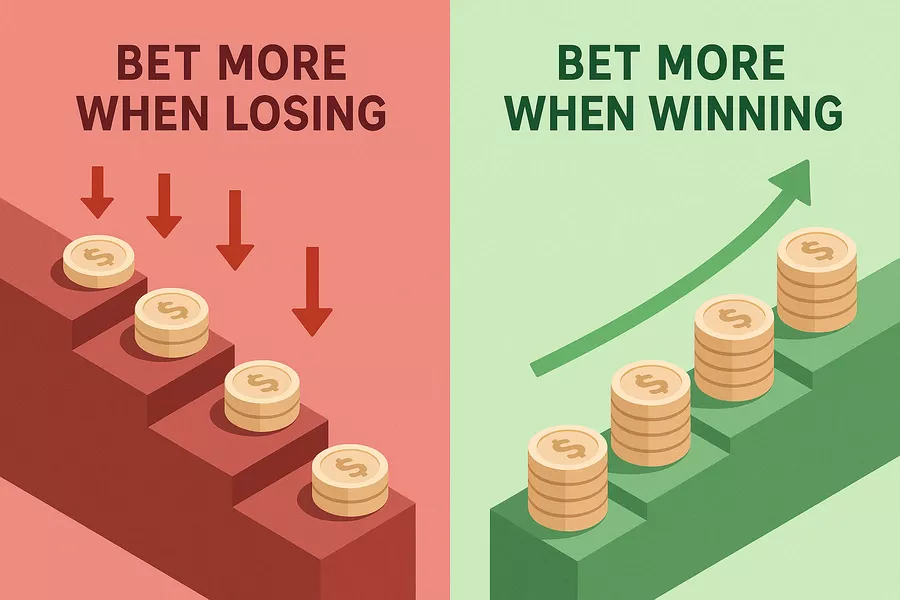
The appeal is obvious. You’re only risking big money when you’re already up. A three-game winning streak at 10-20-40 progression nets you 70 dollars in profit. If you started each bet at 10 dollars flat, you’d only profit 30 dollars. You’re extracting extra value from winning streaks without risking your core bankroll. In theory, you maximize wins during hot runs while protecting yourself during cold ones.
The problem reveals itself when you track long-term results. Winning streaks aren’t predictive. Just because you won two in a row doesn’t mean bet three is more likely to hit. The probability of winning that third bet is the same as it was for bet one. You’re betting more at a point that feels meaningful but isn’t actually different from any other bet. Over a large sample, you’re just adding variance without adding value.
Let’s run the math on a typical sequence. You win three straight using Paroli, netting 70 dollars. Then you lose three straight at your base 10 dollar bet, losing 30 dollars. You’re up 40 dollars, which is better than flat betting those six games. But now consider this sequence: win one, lose one, win one, lose one, win one, lose one. With flat betting at 10 dollars, you break even minus vig. With Paroli, you also roughly break even because you never got a streak going. The system only helps when you hit multiple consecutive wins.
The question becomes: do you hit three-win streaks often enough to offset the added variance? For most bettors, the answer is no. Even with a 55% win rate, the probability of three consecutive wins is about 16.6%. It’s not rare, but it’s not common either. You’ll hit it occasionally, pocket some extra profit, and feel like the system is working. But over thousands of bets, the added variance from betting more during arbitrary sequences costs you money compared to optimal staking.
Positive progression systems like Paroli are less dangerous than Martingale because they can’t blow up your bankroll in one catastrophic sequence. The worst case with Paroli is you lose your base bet repeatedly, which is the same as flat betting. You won’t wake up needing to bet three months rent on the next game to recover. That’s genuinely better. But better than catastrophic doesn’t mean good, it just means less bad.
The psychological benefit of positive progression is real though. Pressing wins feels exciting. It gives you something to look forward to when you hit a streak. It makes betting more engaging than grinding flat bets every day. If that engagement keeps you involved in betting when you’d otherwise quit from boredom, maybe the suboptimal staking is worth it as an entertainment expense. But be honest with yourself: are you using Paroli because it’s strategically superior, or because it’s more fun?
Another positive progression approach is the 1-3-2-6 system, which follows a fixed sequence: bet one unit, then three units, then two units, then six units, resetting after any loss or after completing the sequence. This caps your exposure while trying to capture winning streaks. The logic is similar to Paroli but with a more complex progression pattern.
The 1-3-2-6 system has the same fundamental flaw: it assumes winning streaks are predictable and exploitable. They’re not. You’re just betting more at certain points based on recent results that don’t actually tell you anything about future results. The fixed sequence gives you structure, which some people find comforting, but structure isn’t the same as an edge.
Here’s the bottom line on positive progression: it’s not going to destroy your bankroll like Martingale, but it’s also not going to make you more money than sensible flat betting or percentage betting. You’re trading theoretical optimality for psychological comfort and engagement. That trade might be worth it to you personally, but don’t convince yourself that you’re making a strategically superior decision. You’re making a personal preference decision, which is fine, but call it what it is.
Fibonacci and D’Alembert Systems
The Fibonacci betting system uses the famous Fibonacci sequence 1, 1, 2, 3, 5, 8, 13, 21, 34, 55 where each number is the sum of the previous two. After a loss, you move one step forward in the sequence. After a win, you move two steps back. The progression is slower than Martingale, which makes it feel safer, but slower doesn’t mean safe, it just means you die of different wounds.
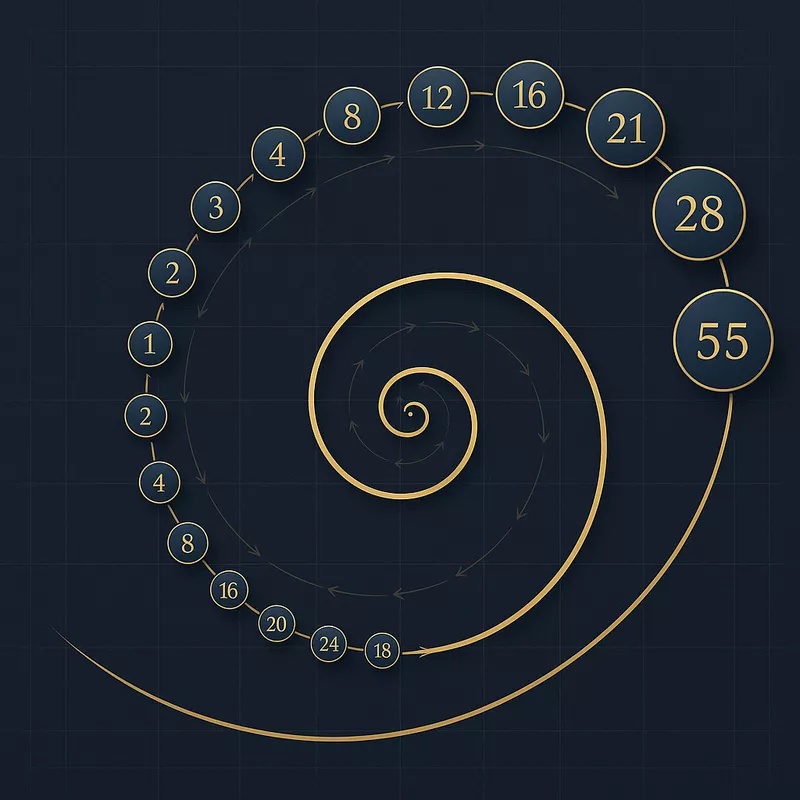
Let’s walk through a Fibonacci sequence so you see the progression. You start betting one unit. You lose, so your next bet is one unit again. Lose, bet two units. Lose, bet three. Lose, bet five. Lose, bet eight. You’re now six bets deep, down 20 units total, and your next bet needs to be 13 units. If you win that 13-unit bet at -110 odds, you get back about 11.8 units, reducing your deficit to 8.2 units. Now you move back two steps in the sequence to betting five units.
The theory is that the slower progression gives you more breathing room than Martingale. You won’t escalate to insane bet sizes after just seven losses. You also don’t need to win the exact bet that recovers everything you can win several smaller bets and slowly grind your way back to even. This feels more manageable psychologically.
The problem is that Fibonacci still suffers from the same core flaw: you’re betting more after losses based on the assumption that a win becomes more likely. It doesn’t. Each bet has the same expected value regardless of what happened before. You’re just risking more money at a time when you can least afford to lose it. The slower escalation means you survive longer than Martingale would, but survival isn’t the goal, profit is, and Fibonacci doesn’t improve your profit expectation.
Here’s what actually happens with Fibonacci over a large sample. You hit normal variance some wins, some losses, nothing unusual. During the win streaks, you’re betting small because you moved back in the sequence. During the loss streaks, you’re betting progressively larger. This means you’re betting small during the stretches where you could be winning more and betting large during the stretches where you’re losing. You’ve literally inverted optimal staking.
The D’Alembert system is another negative progression approach that’s less aggressive than Martingale. Instead of doubling after losses, you increase your bet by one unit. After wins, you decrease by one unit. So you might bet 10, lose and bet 20, lose and bet 30, win and bet 20, win and bet 10. The logic is that over time, wins and losses should roughly balance, and the progression ensures you’re ahead when they do.
D’Alembert feels mathematical and balanced. The one-unit increments seem conservative compared to Martingale’s doubling. You’re not going to bet 1,000 dollars after a bad streak like you would with Martingale. The worst case is you’re betting 100 or 200 after ten straight losses, which seems survivable. And if wins and losses do balance out, you’ll be ahead because you won bigger bets than you lost.
But think about what D’Alembert assumes: that wins and losses balance out in neat, predictable ways. They don’t. You can easily hit sequences like lose eight, win two, lose six, win one, lose seven. Your bet sizing is all over the place, you’re betting big during several of those losing stretches, and by the time you finally get some wins, you’re deeply in the hole. The system doesn’t protect you from normal variance, it just makes normal variance more expensive.
The other issue with D’Alembert is you need to win at least 50% of your bets for it to work, and realistically you need better than 52% because of the vig. If you’re winning 52%, you’re losing 48%, and those won’t balance out evenly. You’ll have more stretches where you’re betting larger amounts and losing than where you’re betting larger amounts and winning. Over time, this costs you money compared to flat betting.
Both Fibonacci and D’Alembert are marketed as “safer” alternatives to Martingale, and they are safer in the sense that they won’t blow up your bankroll in one disastrous sequence. But safer than catastrophic isn’t the same as good. You’re still using negative progression, which means you’re still betting more when you’re losing, which means you’re still fighting against basic mathematics.
If you’re attracted to these systems because they seem more conservative than Martingale, I understand the impulse. But conservative negative progression is still negative progression. The right move isn’t to find a gentler way to bet more after losses, it’s to stop betting more after losses entirely. Switch to flat betting or percentage betting, where your stake sizes are determined by your bankroll and your edge, not by recent results that don’t predict anything.
Labouchere and Other Complex Systems
The Labouchere system, also called the cancellation system, is more complex than the previous systems but still fundamentally flawed. You start by writing down a sequence of numbers that represents your profit goal. A common sequence is 1-2-3-4. To determine your bet size, you add the first and last numbers in your sequence. So 1+4 = 5 units. If you win, you cross off those numbers. If you lose, you add your bet size to the end of the sequence.
Let’s work through an example. Your sequence starts as 1-2-3-4. You bet five units (1+4) and win. You cross off 1 and 4, leaving 2-3. Your next bet is five units again (2+3). You lose, so you add 5 to the sequence: 2-3-5. Your next bet is seven units (2+5). Win, and you cross off 2 and 5, leaving just 3. Your final bet is three units. Win, and your sequence is complete. You’ve profited ten units, which is the sum of your original sequence.
The system feels sophisticated. You’re not just blindly doubling or following a set pattern. You have a target, a plan, a sequence to work through. It feels like you’re in control. But here’s the problem: when you lose, your sequence grows longer and your bets get larger. A bad run can balloon your sequence to something like 2-3-5-7-9-11-13, requiring a 15-unit bet to continue. You’re deep in a hole, betting big to claw your way back, which is just negative progression with extra steps.
Labouchere has the same weakness as all negative progression systems: losing streaks make you bet more when you can least afford it. The fancy sequence mechanics don’t change the underlying math. You’re still risking more based on past results that don’t influence future outcomes. The added complexity just makes it harder to see that you’re walking into the same trap.
The Reverse Labouchere exists too, where you add numbers after wins and subtract after losses. This is positive progression with a complex tracking system. It’s less dangerous than the regular version but also less effective than simpler positive progression approaches like Paroli. You’re adding bookkeeping complexity without improving results.
Oscar’s Grind is another system worth mentioning. You bet one unit after each loss but increase your bet by one unit after each win, with the goal of profiting exactly one unit per cycle. So you bet 1, lose, bet 1, lose, bet 1, win, bet 2, win, and you’re up one unit for that cycle. Then you reset and start over.
Oscar’s Grind is positive progression, so it won’t blow up your bankroll. The problem is it’s painfully slow and doesn’t actually improve your returns. You’re betting small most of the time because you’re usually either losing or just starting to climb back. When you finally get ahead, you reset and start small again. Over time, you’re leaving money on the table compared to flat betting at a higher consistent stake.
All of these complex systems share a common trait: they give you something to do. They provide structure and ritual. They make you feel like you’re following a sophisticated strategy rather than just placing bets. That psychological benefit is real, but it comes at the cost of suboptimal staking and added variance. If you need the structure to stay engaged, fine, but understand that you’re paying for that comfort with reduced expected value.
The other issue with complex systems is they’re easy to screw up. You lose track of your sequence, forget whether you’re supposed to increase or decrease, make a calculation error that throws everything off. With flat betting, you can’t mess up: every bet is the same amount. With percentage betting, you just multiply your bankroll by a percentage. With Labouchere, you’re managing a dynamic sequence that requires attention and accurate record-keeping. More complexity means more room for human error.
Here’s a simple test: if you can’t explain your betting system in one sentence without using pen and paper, it’s too complicated. Flat betting: bet the same amount every time. Percentage betting: bet X% of your current bankroll. Kelly Criterion: bet a percentage based on your edge and the odds. Those are simple. Labouchere: “Write down a sequence, bet the sum of the first and last numbers, cross them off when you win, add your bet size to the end when you lose, and…” Stop. Too complicated.
Why Progressive Systems Persist Despite Failing
If progressive systems don’t work, why do people keep using them? Why do new bettors discover Martingale every year and convince themselves it’s different for them? Understanding the psychology helps you avoid the same traps.
First, progressive systems work in the short term. Martingale will win more sessions than it loses because most sessions don’t hit catastrophic losing streaks. You might go weeks or even months profitably doubling after losses, pocketing small steady wins, feeling like you’ve cracked the code. Then one brutal week hits and erases all that profit plus your original bankroll. Short-term success creates false confidence.
Second, humans are wired to see patterns where none exist. When you use a progressive system during a stretch of normal variance, your brain assigns causation to correlation. You bet more and won, so betting more must have helped. You reset to a small bet and lost, so you should’ve stayed aggressive. You’re constantly reinforcing the narrative that the system works because you’re interpreting random results as meaningful patterns.
Third, progressive systems feel active. Flat betting feels passive, like you’re not really trying. Doubling after losses feels like you’re fighting back, taking control, refusing to accept defeat. This illusion of control is powerful. It makes betting feel less like gambling and more like a strategic contest where your decisions matter. They do matter, just not in the way the system suggests.

Fourth, the sunk cost fallacy kicks in hard with progressive systems. Once you’re five bets deep in a Martingale sequence, down 310 dollars, with a 320 dollar bet staring at you, walking away feels like admitting defeat. If you just win this next bet, you recover everything. Abandoning the system now means all those losses were for nothing. Your brain screams at you to continue, to see it through, to justify the pain by achieving the goal. This is exactly how people go broke.
Fifth, confirmation bias means people remember and share the times progressive systems worked. Someone hits a nice run with Paroli, turns 500 dollars into 2,000 dollars, and tells everyone about their brilliant system. Twenty other people blow up their bankrolls using the same system and don’t mention it because losing isn’t a good story. You hear about the winners, not the losers, which skews your perception of how well these systems actually perform.
The gambling industry also perpetuates progressive systems because they’re profitable for the house. A player using Martingale bets way more total money over a session than a flat bettor does. More action means more vig collected. The house edge stays the same, but it’s applied to a much larger handle. Casinos love Martingale bettors because those bettors eventually go broke but generate huge revenue on the way down.
Sportsbooks don’t mind progressive bettors either. They know the systems don’t work. They know variance will eventually destroy those accounts. In the meantime, those bettors are generating volume, paying vig on larger bets, and usually making poor decisions when they’re deep in a progression. It’s a profitable customer segment from the book’s perspective.
The final reason progressive systems persist is that admitting they don’t work means admitting you were wrong. Nobody wants to feel stupid. If you’ve been using Martingale for six months and someone tells you it’s doomed to fail, your ego resists. You invested time learning the system, money testing it, emotional energy defending it. Walking away means all that was wasted. It’s easier to rationalize that your version is different or that you’ll quit before the big loss happens.
But here’s the thing: every person who ever went broke using Martingale thought they’d quit before it got bad. Every single one believed they’d recognize the danger signs and stop. They were all wrong. You’re not special. You won’t see it coming because the system looks like it’s working right up until the moment it catastrophically isn’t. The big loss doesn’t announce itself, it just arrives one day during a normal session that turns into a nightmare.
When Progressive Betting Might Make Sense
I’ve spent this entire article explaining why progressive systems don’t work, so it might surprise you to hear there are narrow situations where they’re not completely insane. These situations are rare, highly specific, and definitely not what most people using progressive systems are actually doing. But for completeness, let’s cover them.
Positive progression as pure entertainment might be worth the cost if you’re betting primarily for fun rather than profit. If you’re someone who would quit betting entirely because flat betting is too boring, and using Paroli keeps you engaged with sports you enjoy watching, maybe the suboptimal staking is an acceptable entertainment expense. You’re paying a small mathematical cost for significantly more enjoyment. That’s a trade some people reasonably make.
The key word is small mathematical cost. If you’re using wild progressions that add huge variance, the entertainment value isn’t worth the financial risk. But if you’re using a conservative positive progression like Paroli capped at three wins, your results probably won’t differ dramatically from flat betting over a large sample. You might give up 1% or 2% in expected value, which could be worth it if the increased engagement means you stick with betting long-term instead of quitting from boredom.
Tournament betting is another rare case where progressive systems sometimes make sense. If you’re in a betting contest with fixed end date and prizes for top performers, optimal strategy might involve more risk than usual. Aggressive progression could give you a shot at the top spots even if it increases risk of busting. You’re playing for variance in a way that doesn’t make sense for normal bankroll management but could be rational in a tournament structure.
The critical distinction is that you’re consciously choosing to take on extra variance for a specific strategic reason in a limited situation. You’re not deluding yourself that the system has a mathematical edge. You’re making an informed decision to accept worse expected value in exchange for something else you value. That’s fundamentally different from using Martingale because you think it prevents losses.
Very short-term betting with a hard stop could theoretically use negative progression if the time frame is limited enough. If you’re betting for one NFL Sunday with a strict rule that you stop after the late games regardless of results, you might use a mild progression knowing you won’t have time to dig a deep hole. But this requires iron discipline to actually stop, which most people don’t have, so it’s still dangerous even in this limited scenario.
Some professional bettors use modified positive progressions when they have strong quantitative evidence that they can identify varying edge sizes. If their model shows a 4% edge on one bet and a 7% edge on another, they might bet more on the 7% edge opportunity. But this isn’t really progressive betting based on recent results, it’s variable staking based on calculated expected value. The progression just happens to coincide with a winning streak if their edge identification is accurate.
The problem is most bettors wildly overestimate their ability to identify varying edges. What feels like a huge edge is often just a normal bet that you’re more confident about for emotional reasons. Unless you have years of data showing you can accurately classify edge sizes, you’re probably just adding variance without actually betting more on better opportunities.
Here’s the test: can you articulate a specific, concrete reason why progressive betting makes sense in your situation that doesn’t rely on recent results predicting future results? If your answer is “I’m betting more after losses to recover faster” or “I’m betting more after wins because I’m running hot,” those aren’t good reasons. If your answer is “I’m using conservative positive progression as an entertainment enhancement while accepting 1% to 2% reduced EV,” that might be reasonable. Know the difference.
The overwhelming majority of bettors using progressive systems don’t fall into any of these narrow categories. They’re using systems that increase bets based on recent results, hoping to either recover losses faster or capitalize on streaks, without understanding that they’re just adding variance to no benefit. If you’re reading this and thinking “but my situation is different,” it probably isn’t. The math doesn’t care about your personal circumstances.
What to Do Instead
If progressive systems don’t work, what should you do? The answer depends on your experience level and goals, but the core principle is the same: use staking systems that determine bet size based on your bankroll and your edge, not based on your recent results.
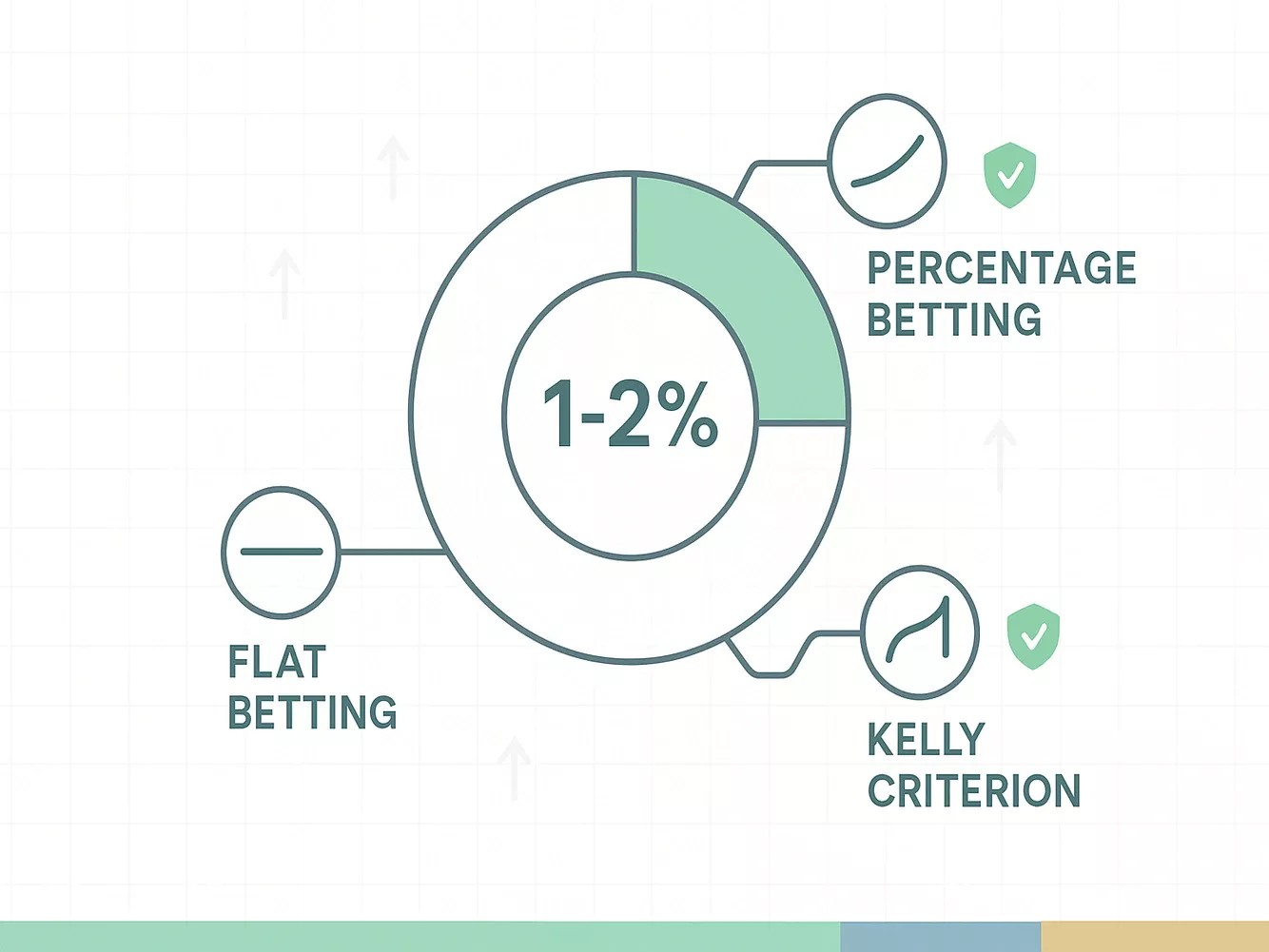
Beginners should use flat betting without exception. Pick a unit size that’s 1% to 2% of your bankroll and bet that same amount on every play. No progressions, no adjustments based on confidence, just the same stake every single time. This removes all psychological traps and lets you focus on the hard part, which is finding value bets. Track your results for at least 200 bets before considering anything more complex.
Intermediate bettors who’ve proven profitability over several hundred bets can explore percentage betting. Calculate 2% to 3% of your current bankroll and bet that amount, adjusting daily or weekly as your bankroll changes. This provides natural compounding during winning periods and protection during losing periods. It’s more sophisticated than flat betting without adding the dangerous assumptions of progressive systems.
Advanced bettors with years of data and proven edges can use the Kelly Criterion or fractional Kelly. Calculate the optimal bet size based on your estimated edge and the odds, but use quarter Kelly or half Kelly to account for probability estimation errors. This maximizes growth while managing variance, but it requires accurate assessment of your win probabilities, which most bettors don’t have.
What you should never do is use Martingale or any negative progression system. Period. There’s no experience level where Martingale makes sense. There’s no bankroll size that makes it safe. There’s no market inefficiency that makes it work. It’s a mathematical disaster that feels logical until it destroys you. If you’re currently using negative progression, stop immediately before variance catches up.
If you’re using positive progression and enjoying it, you need to ask yourself an honest question: are you using it because it’s strategically optimal or because it’s more fun? If the answer is more fun, fine, but cap your progression aggressively and understand you’re paying a small cost for entertainment. If the answer is strategic, you’re wrong, and you should switch to flat betting or percentage betting that will produce better results.
The other critical element is bankroll management regardless of which staking system you choose. Never bet more than 5% of your bankroll on any single play. Maintain a buffer of at least 50 units so you can survive normal variance. Set loss limits for days, weeks, and months so you don’t compound mistakes during cold streaks. These rules matter more than which specific staking system you use.
Track everything. Every bet, every stake size, every result, every sport, every bet type. After 100 bets, review your data and see what’s actually working. You might think you’re crushing NFL but the numbers show you’re barely breaking even. You might think player props are your weakness but you’re actually profitable there. Data reveals truth that your memory and ego hide from you.
The final piece is patience. Progressive systems are popular because they promise to solve problems quickly. Lost money yesterday? Martingale says you’ll recover today. Want to capitalize on momentum? Paroli says you’ll extract maximum value from hot streaks. These promises are false, but they’re appealing because waiting is hard. Flat betting or percentage betting requires accepting that growth is slow, variance is real, and there’s no shortcut to long-term profit.
Accept the wait. Stop looking for systems that make betting more exciting or recovery faster or wins bigger. Start looking for systems that protect your downside, let your edge work over time, and keep you in the game long enough to accumulate thousands of bets where the law of large numbers can materialize. That’s not sexy, but it works, and working is better than exciting.
Progressive Systems: Summary and What to Use Instead
Progressive betting systems don’t work for sports betting. Martingale will eventually destroy you. Fibonacci and D’Alembert will bleed you slower but just as surely. Positive progression systems like Paroli and Oscar’s Grind are less dangerous but still suboptimal compared to flat betting or percentage betting. The complex systems like Labouchere add bookkeeping without adding value.
The reason is simple: progressive systems adjust stake sizes based on recent results that don’t predict future results. Each bet is an independent event. The spread doesn’t care that you lost seven in a row. The total doesn’t care that you won three straight. Your betting history is information only to you, and it’s usually information that leads you astray rather than helping you make better decisions.
The appeal of progressive systems is psychological, not mathematical. They provide structure, create the illusion of control, make you feel active rather than passive. These feelings are real and powerful. But feelings don’t beat mathematics, and mathematics says progressive systems are inferior to simpler approaches that stake based on bankroll and edge rather than recent results.
If you’re using a progressive system right now, this article probably hasn’t convinced you to stop. That’s fine. Keep using it, but start tracking your results honestly. After 500 bets, compare your performance to what you would’ve achieved with flat betting at the same average stake size. The data will tell you what words couldn’t. Some lessons can only be learned through experience, and sometimes that experience is expensive.
For everyone else: stick with flat betting or percentage betting. Learn to find value. Manage your bankroll properly. Accept that growth is slow and variance is real. Stop looking for systems that make betting more exciting and start focusing on systems that actually work. That’s how you survive long enough to profit. Everything else is just expensive entertainment.
See also: betstrategytips – your guide to betting systems.
See also: Bankroll Management Systems – manage your stakes when using Martingale.
