
Bankroll Management Systems for Sports Betting Success
 Available in US
Bankroll Management: Why It Matters More Than Any Betting Pick
Here’s the uncomfortable reality that nobody wants to hear: your bankroll management matters more than your ability to pick winners. You can be the sharpest handicapper in your city, hitting 58% on NFL spreads, and still go broke if you’re betting the wrong amounts at the wrong times. Meanwhile, someone hitting 52% with disciplined bankroll management will be grinding profit while you’re explaining to your friends why you’re taking a break from betting.
Bankroll management is the least sexy topic in sports betting, which is exactly why most people ignore it. Everyone wants to talk about finding value, beating closing lines, exploiting market inefficiencies. Those things matter, but they’re worthless if you blow your entire roll during a normal cold streak because you were betting 10% per game. You can’t compound profits if you bust out, and most bettors bust out not because they’re bad handicappers but because they’re terrible at managing money.
The cruel irony is that bankroll management is simple compared to handicapping. You don’t need to understand advanced statistics or build models or study injury reports. You need to follow basic rules about bet sizing, loss limits, and bankroll protection. The rules are straightforward. Following them consistently is what’s hard, because it requires discipline instead of intelligence, and discipline is in shorter supply.
This guide covers everything you need to know about bankroll management systems. We’ll start with the fundamentals that every bettor needs regardless of experience level, then move into specific systems like fixed units, percentage betting, and Kelly Criterion. You’ll learn how to set up your bankroll properly, how to choose unit sizes that match your goals and risk tolerance, and how to protect yourself during the inevitable stretches where nothing goes right.
We’ll also cover the psychological aspects that bankroll management solves. The systems aren’t just about math, they’re about preventing the emotional decisions that destroy accounts. Chasing losses, pressing bets after wins, betting too much on games you’re overly confident about proper bankroll management eliminates these traps by making decisions mechanical rather than emotional.
If you’re currently betting without a formal bankroll management system, you’re playing with fire. Maybe you’ve been lucky so far. Maybe you haven’t hit a brutal losing streak yet. Maybe you’ve actually been winning despite poor money management. That luck will run out, and when it does, you’ll wish you’d established proper systems before the crisis instead of after it destroyed you.
The goal isn’t to make bankroll management fun or exciting. The goal is to make it automatic, boring, and effective. The best bankroll management system is one you barely think about because you set it up correctly at the beginning and now it just runs itself. That’s what we’re building here.
Why Bankroll Management Matters More Than You Think
Most bettors approach sports betting like they approach buying lottery tickets. They deposit some money, bet whatever amounts feel right in the moment, and hope for the best. When they’re winning, they bet more because they feel hot. When they’re losing, they bet more to recover faster. Their bet sizes are determined by emotion, confidence, and availability of funds rather than any coherent strategy. This approach guarantees eventual failure.
The mathematics of sports betting are unforgiving. To break even betting standard spreads and totals at -110, you need to win 52.4% of your bets. That’s the number where the vig gets paid and you don’t lose money. Anything below 52.4% and you’re bleeding bankroll. Hit 55% and you’re making meaningful profit. The difference between 52% and 55% seems tiny, but over hundreds of bets, it’s the difference between going broke and building wealth.
Here’s the problem: even if you’re genuinely skilled at 55%, normal variance means you’ll have stretches where you hit 45% or worse. During a 100-bet sample, a 55% bettor will sometimes go 50-50 or even 48-52. That’s not bad luck, that’s expected variance. If you’re betting 10% of your bankroll per bet during those stretches, you’re crippled or dead before your true win rate has time to emerge. Proper bankroll management keeps you alive long enough for the math to work.
Think of bankroll management as insurance against variance. You’re protecting yourself from the statistical reality that short-term results don’t always reflect long-term expectations. The insurance isn’t free by betting smaller amounts, you’re growing slower during winning periods than you would with aggressive staking. But the protection during losing periods is worth far more than the opportunity cost during winning ones.
The other critical function of bankroll management is preventing emotional decisions. When you have clear rules about bet sizing, you can’t get yourself in trouble by escalating stakes after losses or pressing after wins. The system removes the decision from your hands. You’re not asking yourself “how much should I bet on this game?” based on how you feel. You’re calculating a number based on predetermined rules and betting that amount. Emotion doesn’t enter the equation.
Professional bettors obsess over bankroll management in a way that recreational bettors find baffling. The pros aren’t smarter or more disciplined by nature, they’ve just learned through expensive experience that bankroll management is the foundation everything else builds on. Your handicapping edge might be 3% or 4% if you’re good. Poor bankroll management can easily cost you 5% or 10% in expectation through suboptimal staking and emotional mistakes. You’re giving away more than your edge generates.
The psychological benefit is equally important. When you’re following a proper bankroll management system, you can lose five or ten bets in a row without panicking. You know you have 90% of your bankroll left. You know this is normal variance. You know your bet sizes are appropriate and you’re not in danger of busting out. That psychological security lets you stay calm, stick with your strategy, and avoid the desperate mistakes that compound losses into disasters.
Without bankroll management, every losing streak feels like a crisis. You’re constantly worried about going broke. You start pressing to recover losses. You take worse lines because you need winners immediately. You bet games you shouldn’t bet because you’re trying to get back to even before the week ends. The lack of structure creates anxiety, and anxiety creates mistakes, and mistakes cost money. The system isn’t just protecting your bankroll, it’s protecting your judgment.
Setting Up Your Betting Bankroll Properly
Before you can manage a bankroll, you need to establish one correctly. This is where most people make their first mistake: they don’t properly separate their betting money from their living money. They just deposit whatever they have available in their sportsbook account and start betting. This creates problems immediately because you’re betting with money that has emotional attachments and practical purposes beyond sports betting.
Your betting bankroll should be money you can afford to lose completely without affecting your life. Not money you’d prefer not to lose money that could vanish tomorrow and you’d be fine. No missed rent payments. No skipped groceries. No credit card debt to cover the loss. If losing your betting bankroll would create financial stress in your actual life, you don’t have a proper bankroll, you have a problem waiting to happen.
The reason this separation matters is psychological as much as practical. When you’re betting with money that might be needed for bills, every loss creates anxiety beyond the monetary amount. You’re not just down 100 dollars, you’re potentially short on rent. That anxiety affects your decision-making. You start taking worse bets because you need to win rather than because the bets have value. You chase losses more aggressively. You can’t think clearly about strategy when you’re worried about practical consequences.
Most experts recommend starting with a minimum bankroll of 500 to 1,000 dollars if you’re serious about sports betting. You can start smaller, but small bankrolls limit your betting options and make variance more painful. At 300 dollars with 2% units, you’re betting 6 dollars per game. Many sportsbooks have 5 to 10 dollar minimums, which means you’re either violating your system or unable to bet certain markets. Better to save up until you have enough capital to implement your system properly.
The upper limit depends on your financial situation and goals. If you’re treating betting as serious supplemental income, you might build a 5,000 to 10,000 dollar bankroll. If you’re trying to become a professional bettor, you need significantly more probably 25,000 dollars minimum to generate meaningful income at reasonable unit sizes. If you’re betting primarily for entertainment with hopes of profit, 1,000 to 2,000 dollars is a comfortable starting point.
Once you’ve determined your bankroll amount, you need to keep it separate from your regular finances. The simplest approach is to keep your betting money in your sportsbook account and treat that balance as your bankroll. Alternatively, you can maintain a separate bank account specifically for betting funds. The key is physical and psychological separation so you’re always clear about what money is bankroll versus what money is for living expenses.
Never borrow money to create or replenish a bankroll. Never use credit cards to deposit. Never take money from savings that you might need for emergencies. These are obvious rules, but people break them constantly when they’re on a losing streak and desperate to keep betting. The moment you’re borrowing or using money that has other purposes, you’ve crossed from betting into problem gambling territory.
You also need to decide on a replenishment and withdrawal policy. Many successful bettors use a quarterly system: every three months, they withdraw 50% of any profits and add that to their personal finances. If they’re down, they don’t add money unless they’ve saved it separately and still meet the “afford to lose completely” standard. This creates a natural check on losses while allowing winners to extract profit rather than letting everything ride indefinitely.
The other important setup decision is whether to have one bankroll for all betting or separate bankrolls for different sports or bet types. Most bettors use one unified bankroll because it simplifies tracking and allows money to flow naturally to wherever you’re finding value. But if you’re significantly better at one sport than others, you might maintain a larger bankroll for your primary sport and smaller ones for secondary markets. This prevents you from risking too much on sports where your edge is unproven.
The Unit System Explained
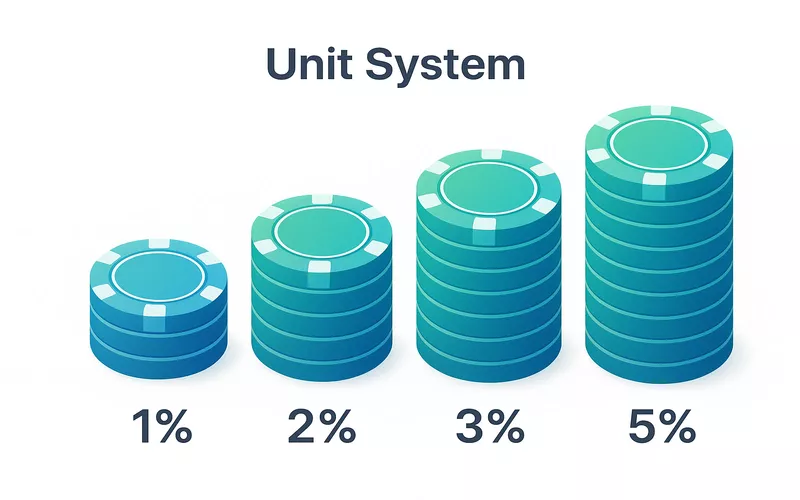
The unit system is the foundation of bankroll management. A unit is your standard bet size, typically expressed as a percentage of your total bankroll. Instead of thinking in dollar amounts that change meaning as your bankroll grows or shrinks, you think in units that automatically scale appropriately. This standardization makes tracking results simple and keeps your stake sizes proportional to your capital.
Here’s how it works practically. You have a 1,000 dollar bankroll and decide one unit equals 2% of your bankroll. Your unit is 20 dollars. Every bet you make is expressed in units. A standard bet is one unit. A high-confidence bet might be two units. You track your results in units won or lost. After 100 bets, you’re up 15 units, which equals 300 dollars at your current unit size. Simple, clear, scalable.
The beauty of the unit system reveals itself over time. Say you’re up to 1,500 dollars after a good month. Your 2% unit is now 30 dollars instead of 20. You’re automatically betting more because your bankroll grew, which accelerates your growth without any conscious decision to increase stakes. Conversely, if you drop to 800 dollars during a bad stretch, your unit shrinks to 16 dollars. You’re automatically betting less, which protects your remaining capital and gives you more runway to survive the downswing.
Choosing your unit size is the most important decision in bankroll management. Conservative bettors use 1% units. Standard is 2% to 3%. Aggressive approaches go to 4% or 5%, though anything above 3% creates serious variance issues that most bettors underestimate. Your choice should be based on your risk tolerance, your proven edge, and your psychological ability to handle swings.
Think about what different unit sizes mean for your survival. At 1%, you can lose 100 straight bets before going broke. That’s absurd over-protection, but it shows the philosophy: maximum safety, minimum variance. At 5%, you’re broke after 20 straight losses. That sounds survivable until you realize that even at 55% win rate, you’ll hit stretches of 10 to 15 losses over any significant sample. At 5%, those stretches are catastrophic. At 2%, they’re painful but manageable.
Most professional bettors settle around 2% to 3% because it balances several factors. You’re growing meaningfully when you’re winning without courting disaster during normal variance. You can survive a 20-game losing streak and still have 60% to 70% of your bankroll intact. That’s enough to keep betting at reasonable sizes and let your edge work its way back. The growth isn’t optimal, but the survival probability is excellent, and survival beats growth every time.
One critical detail that beginners mess up: your unit size should be based on your actual bankroll, not your initial deposit. If you started with 1,000 dollars at 2% units and you’re now at 1,200 dollars, your unit is 24 dollars, not 20. You need to recalculate periodically as your bankroll changes. How often you recalculate depends on your betting volume. High-volume bettors might adjust daily. Weekly is a good middle ground. Monthly is too infrequent because your unit size drifts too far from appropriate levels.
The other decision is whether to use fixed units or variable units. Fixed units means you bet one unit on every play regardless of confidence or situation. Variable units means you might bet one, two, or three units depending on how much edge you perceive. Most professionals use variable units with strict criteria, but beginners should absolutely use fixed units. You don’t yet know what a two-unit play actually is, and you’ll just convince yourself that games you like more deserve bigger bets when really they’re just games you feel more confident about, which isn’t the same thing.
If you eventually move to variable units, the key is having clear, objective criteria. A two-unit play isn’t “I really like this one.” It’s “this bet has at least 5% more edge than my typical bet based on my model” or “this bet beat the closing line by three points on a key number.” Measurable factors that you can backtest and verify actually correlate with better results. If you can’t articulate objective criteria for scaling units, stick with fixed units until you can.
Fixed Unit Betting System
Fixed unit betting is the simplest bankroll management system and the one I recommend for absolutely everyone starting out. The rules are dead simple: determine your unit size as a percentage of your bankroll, and bet exactly that amount on every single play. No adjustments for confidence. No scaling based on odds. No pressing after wins or increasing after losses. Every bet is one unit, every single time.
The psychological benefits are enormous. You can’t get yourself in trouble by escalating bets during losing streaks because the system doesn’t allow it. You can’t press after wins because you feel hot. You can’t convince yourself that this particular game deserves three units because you’re “really sure” about it. The system removes all these decision points that typically lead to errors. You calculate your unit size once, and then you just bet that amount repeatedly without thinking about it.
Fixed unit betting also makes tracking results trivially easy. After 100 bets, you won 55 and lost 45. You’re up 10 units. At -110 average odds, that’s roughly a 55% win rate. You know exactly how you’re performing without any complicated calculations to account for variable bet sizes. Your return on investment is clear. Your win rate is clear. Your profit is clear. The simplicity eliminates any ambiguity about whether your strategy is working.
The system protects you during variance in the most important way: it prevents catastrophic losses. Every losing streak hurts the same amount per bet. Lose ten in a row and you’re down ten units, which is 20% of your bankroll if you’re betting 2% units. That’s painful but survivable. You have 80% of your roll left and plenty of runway to let your edge work. Compare that to variable staking where you might’ve convinced yourself to bet three units on several of those losses and you’re down 15 or 20 units instead. The difference between wounded and crippled.
The downside of fixed unit betting is opportunity cost when you genuinely have varying edge sizes. If you can accurately identify that some bets have significantly more value than others, you’re leaving money on the table by betting the same amount on everything. A bet where you have 7% edge deserves more capital than a bet where you have 3% edge. Fixed units ignore this distinction and treat all value the same.
But here’s the critical question: can you actually identify varying edge sizes accurately? Most bettors vastly overestimate this ability. What feels like a huge edge is often just a normal bet that you’re emotionally attached to for some reason. The game involves your favorite team, or a storyline that interests you, or a matchup you’ve been following closely. That emotional involvement masquerades as genuine edge when really it’s just bias.
Unless you have years of tracked data showing that your high-confidence bets actually hit at higher rates than your normal bets, you probably can’t distinguish edge sizes accurately. And if you can’t distinguish edge sizes, variable units are just adding variance without adding value. You’re betting more on some games based on feelings rather than facts, and feelings are expensive in sports betting.
Fixed unit betting is perfect for beginners, ideal for intermediate bettors who haven’t proven they can identify varying edges, and still used by many professional bettors who’ve learned that simplicity beats complexity when the results are roughly equivalent. If you’re reading this and thinking fixed units sound too basic, there’s a very good chance fixed units are exactly what you should be using. Boring systems work. Exciting systems are usually expensive.
The modified fixed unit approach is worth mentioning: you bet one unit on 90% of plays and two units on rare situations where you have overwhelming evidence of extra edge. But those two-unit plays should be extremely rare maybe 5% to 10% of your total bets and based on objective criteria you’ve backtested. If you’re betting two or three units on 30% of your plays, you’re not using fixed units anymore, you’re using variable units poorly.
Percentage-Based Bankroll Management
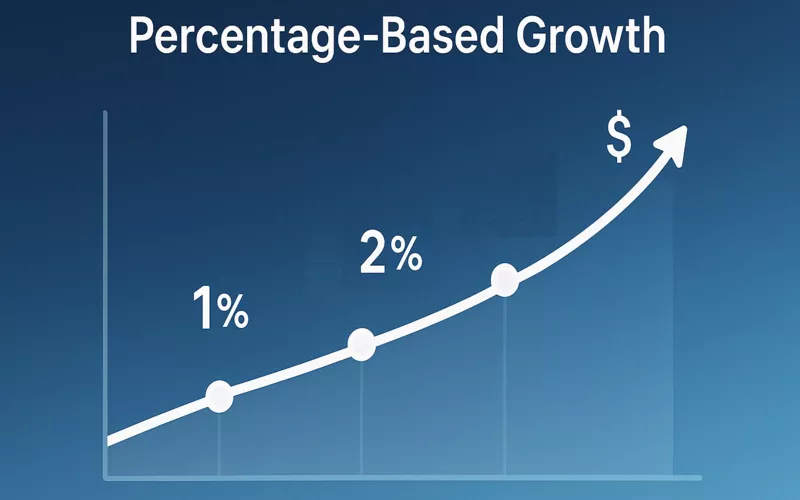
Percentage betting is the next evolution after fixed units. Instead of betting a set dollar amount, you bet a fixed percentage of your current bankroll. If you’re using 2% percentage betting and your bankroll is 1,000 dollars, you bet 20 dollars. When your bankroll grows to 1,200 dollars, you automatically bet 24 dollars. When it drops to 900 dollars, you bet 18 dollars. The percentage stays constant but the dollar amount floats with your bankroll.
The key advantage is natural compounding during winning periods and automatic protection during losing periods. When you’re winning, your bets grow larger, which accelerates your profit curve. When you’re losing, your bets shrink, which extends your survival time and gives you more opportunities to turn things around. You’re always betting an appropriate amount relative to your current capital without any manual adjustments.
The mathematics work out favorably over time. With fixed dollar betting, your profit is linear each win produces roughly the same profit regardless of your bankroll size. With percentage betting, your profit is exponential. Each win increases your bankroll, which increases your next bet, which increases your potential profit. Over hundreds or thousands of bets, this compounding effect becomes significant. A 10% return on 1,000 dollars is 100 dollars. A 10% return on 2,000 dollars is 200 dollars. Percentage betting captures that scaling automatically.
The downside is psychological volatility. Your bet sizes are constantly changing, which feels unstable to many bettors. You’re betting 20 dollars one day, 22 the next, 19 after a loss, 24 after a few wins. Some people find this floating stake size unsettling. They want the consistency of knowing every bet is exactly 20 dollars. The variance in bet sizing creates mental friction even though it’s mathematically sound.
There’s also the recalculation burden. Technically, you should check your bankroll before every bet to calculate the correct percentage. If you’re betting five or ten times per day, this gets tedious fast. Most percentage bettors compromise by recalculating once daily or once weekly rather than before each bet. This introduces small drift from true percentage betting but saves enormous time and reduces decision fatigue.
Choosing the right percentage is critical and should be based on your edge, risk tolerance, and psychological makeup. Conservative percentage betting is 1% to 1.5%. Standard is 2% to 3%. Aggressive is 3% to 5%, though I’d argue anything above 3% is unnecessarily risky for most bettors. The higher your percentage, the faster you grow when winning but also the harder you crash during variance.
Consider the practical implications. At 2%, a 20-game losing streak costs you about 33% of your bankroll. That’s brutal but survivable. At 4%, the same streak costs you about 55% of your bankroll. You’re crippled, your unit size has halved, and your path back to even is much longer and steeper. The extra growth during winning periods rarely justifies the added danger during losing periods unless you have an exceptional proven edge.
The other decision point is whether to count pending bets when calculating your bankroll. Say you have 1,000 dollars and you bet 20 dollars on a game that hasn’t settled. For your next bet calculation, is your bankroll 1,000 or 980? Most bettors ignore pending bets and only adjust based on settled results. It’s simpler and the difference is usually trivial unless you’re betting large numbers of simultaneous games.
Percentage betting makes sense for intermediate to advanced bettors who’ve proven profitability with fixed units and want to optimize growth. It’s not ideal for beginners because the floating stakes add complexity during the learning phase when you’re trying to master handicapping and develop discipline. Get comfortable with fixed units first, prove you can win consistently, then consider moving to percentage betting to accelerate your compounding.
Some bettors use modified percentage betting with minimum and maximum caps. Maybe you’re betting 2% of your bankroll but never less than 10 dollars and never more than 100 dollars. The minimum prevents your bets from becoming insignificantly small during major downswings. The maximum prevents your stakes from escalating beyond your psychological comfort zone during huge upswings. The caps reduce the mathematical optimality slightly but can make the system more livable.
Kelly Criterion for Bankroll Management

The Kelly Criterion is the mathematically optimal staking system for maximizing long-term bankroll growth. It calculates the exact percentage of your bankroll you should bet based on your edge and the odds offered. The formula is elegant: f = (bp – q) / b, where f is the fraction to bet, b is the decimal odds minus one, p is your probability of winning, and q is your probability of losing.
Let’s work through a realistic example. You’re betting an NFL spread at -110, which converts to decimal odds of about 1.909. You estimate you have a 54% chance to win this bet. Plugging into Kelly: f = ((1.909 – 1) × 0.54 – 0.46) / (1.909 – 1) = (0.491 – 0.46) / 0.909 = 0.034. Kelly recommends betting 3.4% of your bankroll on this bet.
That seems reasonable until you start exploring different scenarios. If you think you have a 57% edge at the same -110 odds, Kelly says bet 7.6% of your bankroll. If you think you have 60% edge, Kelly recommends 11.4%. These are massive stakes that would terrify most bettors, but mathematically, if your probability estimates are accurate, these are the optimal bet sizes for maximum growth.
The critical phrase is “if your probability estimates are accurate.” This is where Kelly breaks down in practice. Most bettors overestimate their win probability by 3% to 5% minimum. If you think you’re 56% but you’re actually 52%, Kelly has you betting way too much. This is called over-betting and it’s catastrophic. You’re risking too much relative to your true edge, which increases variance dramatically and can destroy your bankroll during normal downswings.
Kelly is also extremely sensitive to errors in probability estimation. A small mistake in your estimated win rate produces a large error in the recommended stake. The formula amplifies your errors, which means over-betting is far more dangerous than under-betting. Betting half Kelly when Kelly says 10% costs you some growth. Betting 20% when Kelly should say 10% can ruin you.
That’s why virtually every serious bettor who uses Kelly uses fractional Kelly typically quarter Kelly or half Kelly. If full Kelly says bet 8%, half Kelly means bet 4%. If full Kelly says 12%, quarter Kelly means bet 3%. You’re sacrificing theoretical growth in exchange for massive practical benefits: reduced variance, protection against probability estimation errors, and swings you can actually tolerate psychologically.
Fractional Kelly is the only version that makes sense for sports betting. Full Kelly assumes your probability estimates are perfect, which they aren’t. Even professional bettors with sophisticated models use fractional Kelly because they understand their models have error margins. If the pros won’t use full Kelly, you absolutely shouldn’t either.
The challenge with Kelly is you need accurate win probabilities for every bet. You can’t just use your gut feeling or confidence level. You need actual data from hundreds of tracked bets showing your true win rate in similar situations. Without historical data to calibrate your probability estimates, you’re just guessing, and guessing with Kelly is dangerous because the formula magnifies your errors.
Here’s a practical approach for implementing Kelly. First, track at least 200 to 300 bets using fixed units or percentage betting. Calculate your actual win rate by sport, bet type, and odds range. Use this historical data to inform your probability estimates going forward. Apply quarter Kelly to be conservative. Only move to half Kelly once you have 500-plus bets showing your edge is stable and your probability estimates are accurate.
You also need to recalculate Kelly for every single bet because the recommended stake changes based on odds and estimated probability. A -110 bet where you estimate 55% requires different sizing than a +150 bet where you estimate 48%. This adds significant complexity. For every bet, you’re estimating probability, plugging numbers into the formula, and calculating stake size. For casual bettors, this might be manageable. For high-volume bettors placing ten bets daily, it’s exhausting.
The alternative is to simplify by grouping similar bets and using standard probabilities. Maybe you assume 54% on all NFL spreads at -110 and 52% on NBA totals at -115. Calculate Kelly once per category and use those stakes for all bets in each category. You lose precision but gain practicality. For most bettors, this compromise makes more sense than trying to calculate unique stakes for every individual bet.
Kelly works best for experienced bettors who have years of data, quantitative models or strong handicapping records, and the mathematical comfort to implement the system correctly. If any of those pieces is missing, you’re better off with simpler systems. Kelly is powerful in skilled hands and dangerous in inexperienced ones.
Protecting Your Bankroll Through Rules and Limits

Systems for determining bet size are only half of bankroll management. The other half is protection rules that prevent catastrophic mistakes during emotional moments. These rules aren’t suggestions, they’re requirements for survival. Most bettors blow up not because their staking system failed but because they violated basic protection rules during losing streaks or moments of overconfidence.
The first and most important rule: never bet more than 5% of your bankroll on a single play. Ever. Regardless of how confident you are, how much edge you think you have, or how desperate you are to recover losses. Five percent is the absolute ceiling, and honestly, that’s still too high for most situations. If you’re using proper Kelly or percentage betting at 2% to 3%, you’ll rarely approach 5% anyway. But the hard cap prevents momentary insanity from destroying you.
The second rule is maintaining loss limits. Decide in advance how much you’re willing to lose in a day, a week, and a month. Common limits are 10% of bankroll daily, 20% weekly, 30% monthly. When you hit a limit, you stop betting immediately and take a break. No exceptions. No “just one more bet to get close to even.” The limit exists to prevent you from compounding mistakes during cold streaks when your judgment is impaired.
Loss limits feel like quitting, which is why people resist them. They’re not quitting, they’re damage control. Variance happens to everyone. Professional bettors hit stretches where nothing goes right. The difference between pros and broke amateurs is that pros stop betting when they hit predetermined limits. They know that trying to bet their way out of a hole usually digs the hole deeper. Take the loss, clear your head, come back tomorrow with fresh perspective.
The third rule is having a withdrawal strategy. When your bankroll grows significantly, take some profit out. A common approach is withdrawing 25% to 50% of profits quarterly. This accomplishes several things: it locks in real money you can spend or save, it prevents you from risking all accumulated profits during a future downswing, and it reminds you that the goal is making actual money, not just growing numbers on a screen.
Some bettors resist withdrawals because they want to maximize compounding. They’d rather let everything ride and grow as fast as possible. This is fine if you’re treating betting as long-term wealth building and you don’t need the money. But for most people, taking profits periodically provides psychological benefits worth more than the slightly reduced growth rate. Seeing real money in your bank account reinforces that your strategy works.
The fourth rule is never chasing losses by increasing bet size. This seems obvious, but it’s the most commonly broken rule in sports betting. You’re down five units, you feel like you’re due for winners, so you bet three units on the next game to get back faster. That bet loses and now you’re down eight units and considering a five-unit bet. This is how people turn bad weeks into catastrophic months.
Your bet size should be determined by your bankroll and your system, not by your recent results. If you’re using 2% units and your bankroll is 1,000 dollars, you bet 20 dollars. You don’t bet 40 because you’re down 100 and want to recover faster. You don’t bet 10 because you’re scared after a losing streak. You bet 20 because that’s what the system says. The system doesn’t care about your emotions, and that’s a feature, not a bug.
The fifth rule is keeping detailed records of every bet. Track the date, sport, bet type, odds, stake size, and result. After 100 bets, review your data and identify patterns. Maybe you’re profitable on NFL but losing on NBA. Maybe your totals are crushing but your spreads are breakeven. Maybe you’re significantly better on underdogs than favorites. You can’t optimize your strategy without data showing what’s actually working versus what you think is working.
Most bettors don’t track bets because it feels like homework. It’s actually the difference between knowing you’re profitable versus hoping you’re profitable. Your memory is unreliable. You remember big wins more clearly than small losses. You overestimate your win rate because cognitive bias warps your perception. Data doesn’t lie. After 500 tracked bets, the numbers tell you the truth about your performance, and that truth informs better decisions going forward.
Bankroll Management: Summary and How to Set Up Your System Today
Bankroll management isn’t the exciting part of sports betting, but it’s the most important part. You can be a mediocre handicapper with excellent bankroll management and make steady profit. You can be a brilliant handicapper with poor bankroll management and go broke. The difference isn’t talent or knowledge, it’s discipline and system adherence.
The right bankroll management system for you depends on your experience level, risk tolerance, and betting goals. Beginners should use fixed unit betting at 1% to 2% of bankroll. Intermediate bettors can explore percentage betting at 2% to 3%. Advanced bettors with proven edges can implement fractional Kelly. But regardless of which system you choose, the core principles remain the same: never bet more than 5%, maintain loss limits, take profits periodically, never chase losses, and track everything.
The systems aren’t complicated. Following them consistently is what’s hard because it requires patience during winning periods when you want to press and discipline during losing periods when you want to recover faster. The bettors who succeed long-term are the ones who understand that bankroll management is boring by design. Boring means no emotional decisions. Boring means no catastrophic mistakes. Boring means still being in the game next year.
If you take one thing from this article, make it this: set up your bankroll management system properly before you place another bet. Choose your unit size, decide on your staking method, establish your loss limits, commit to tracking every bet. Do this now while you’re thinking rationally, not during a crisis when you’re emotional. The system is your protection against yourself during the inevitable moments when discipline wavers and emotion threatens to override judgment.
Bankroll management won’t make you a better handicapper, but it will make you a better bettor. And being a better bettor is what matters when the goal is long-term profit rather than short-term excitement. Set up your systems, follow your rules, track your results, and give yourself the best possible chance to survive variance and let your edge compound over time. That’s how you win at sports betting.
See also: betstrategytips – master your betting strategy.
See also: Martingale Betting System – a popular system that needs strict bankroll control.
